Featured Post

It seems Pope Francis needs to brush up on his Tertullian!

It has been reported (in The ChristLast Media, I must note) that the current Pope does not like the phrase "lead us not into temptation...

"Let no freedom be allowed to novelty, because it is not fitting that any addition should be made to antiquity. Let not the clear faith and belief of our forefathers be fouled by any muddy admixture." -- Pope Sixtus III

Friday, June 13, 2014

This widow needs 80 grand for two propellers.


Why should we bother restoring a P-61 night fighter to flying condition?

Forget history. Forget the fact she'll be the only one in the world capable of flight. Forget that your humble narrator is dying to see her take off.

Let's do it because she is an incredibly beautiful thing to behold!

Here's a view of the Black Widow's fine backside from the Mid-Atlantic Air Museum's World War II Weekend June 7, 2014:
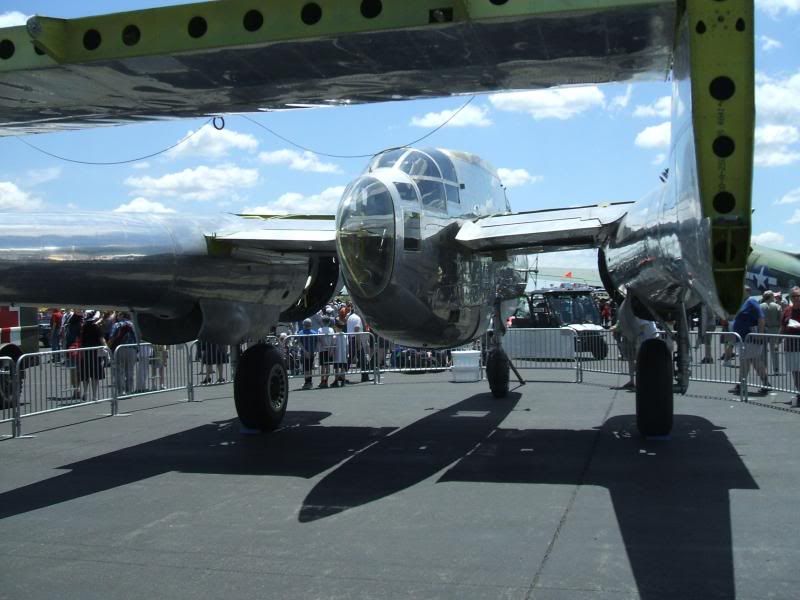
 photo P-61tail.jpg

For more than forty years Black Widow 239445 had lain neglected on a foreign mountainside.   The aircraft was all but forgotten, were it not for the single-minded determination displayed by the Mid-Atlantic Air Museum's co-founder Gene Strine in finding, recovering, and restoring this one-of-a-kind World War II combat aircraft.


Although recovery and restoration costs will represent an estimated 2.2 million dollars, monetary worth cannot be placed on this historic and valuable aircraft. Its worth can be attributed to the value we place on the men and women who designed and built this unique fighter, and to those brave men who flew and maintained this great aircraft.
 
The Mid Atlantic Air Museum requests your support through one of the following donation categories:


$50 - You will receive a P-61 Black Widow Recovery and Restoration Team Certificate, suitable for framing as our thank-you gift.


$100 - In addition to the certificate, you will get a souvenir piece of P-61 aircraft skin from P-61B "42-39445". This skin, approximately 4 inches square, was removed during restoration and is certified by the Museum to be a piece original to the aircraft.  In addition, your name will be engraved on the P-61 "Sponsor's Wall" in the Museum.


$500 - In addition to all of the above, you will receive a resin-cast and hand-detailed 1/72 model of a P-61B.

$1,000 or more - You will receive all the items above, plus a limited-edition P-61 print by David Lee Sample.


Even if you can not afford to donate at one of these levels, every dollar counts and we will be grateful for any support you can give. 

You may donate as little as $5 by credit card on our  MAAM Online Store.  Thank-you.

Please send your donations to :

Mid Atlantic Air Museum
11 Museum Drive
Reading, PA 19605
call:
(610) 372-7333

or visit the online store to use your credit card to donate.


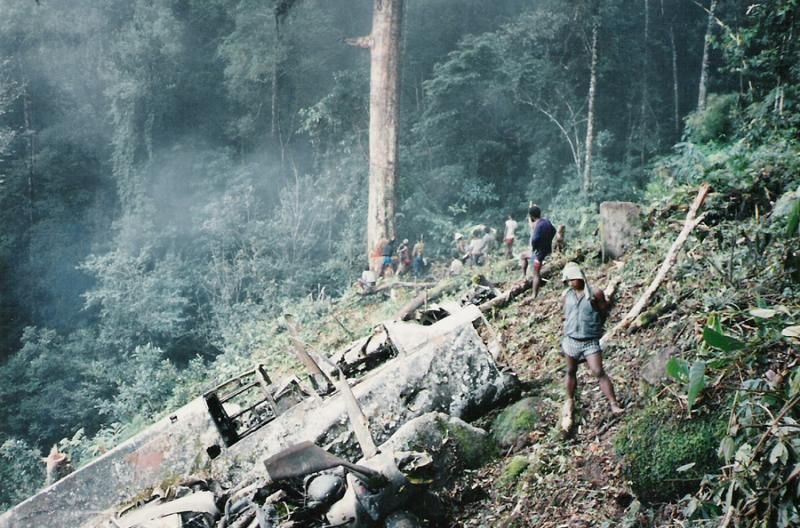
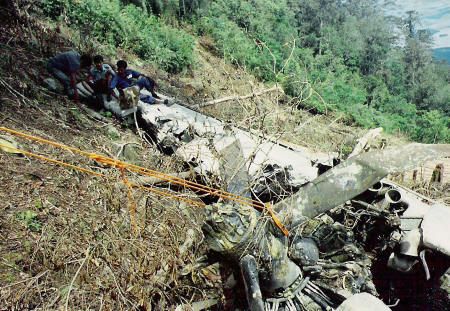
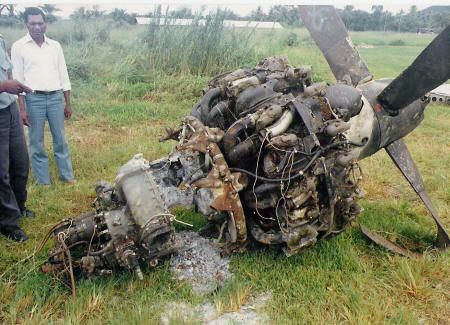
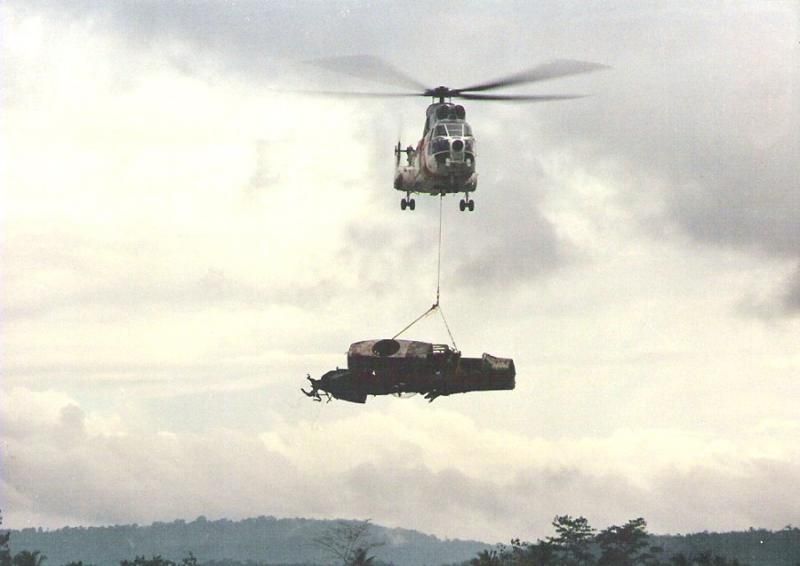
Here's what she looked like when she was pulled out of the Indonesian jungle:
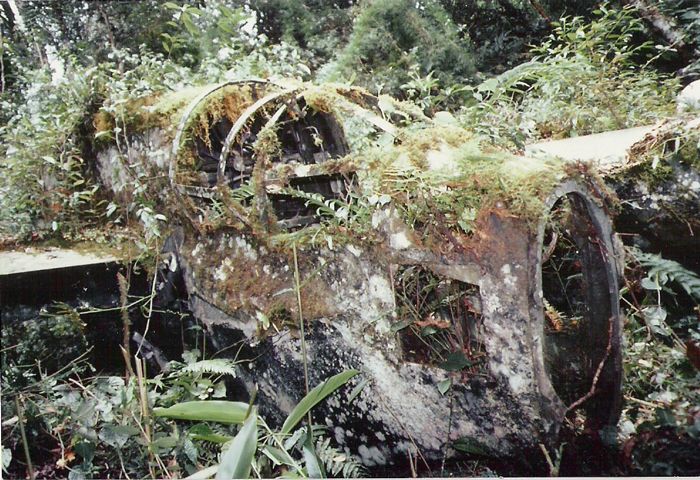

 photo wreck_700.jpg

 photo p61_56.jpg

 photo p61_84_small.jpg

 photo p61_76_small.jpg

 photo p61_48.jpg

Here's the remarkable story of this beauty's recovery from The Widow's Web:

The Mid-Atlantic Air Museum was formed in 1980 for the purpose of acquiring the right to recover P-61B # 42-39445 from its mountaintop crash site.  The museum's ultimate goal was to return the plane to its facility in Reading, Pennsylvania and restore it to flying condition.


Conquering Cyclops
 By: Bob Chubb
EXCERPT REPRINTED FROM WARBIRDS JOURNAL - WINTER 2003 ISSUE
with illustrations from the MAAM files


On 10 January 1945, shortly before noon, with the temperature nearing 100 degrees at the Hollandia airfield, New Guinea, a pilot, radar operator and two passengers climbed aboard their newly acquired P-61B Black Widow in order to perform a proficiency flight.  The two Pratt & Whitney R-2800 engines both roared to life, the wheel chocks were pulled away and the almost 15 ton aircraft began to taxi to the end of the main runway.  After the crew completed their preflight checklist the brakes were released and the aircraft began its takeoff roll down the runway and then lifted off for its flight.

At a mere two miles off the end of the Hollandia runway the summit of Mount Cyclops rose abruptly to 7000 feet above sea level.  On this day the crew would put the vertical climbing performance of their new aircraft to the test.  The pilot made two high speed passes low over the flat coral airstrip and then attempted to pull up and clear the 7000 foot summit of the Cyclops.  With each pass the P-61 failed to clear the summit, but the pilot successfully turned away, abandoning both attempts.  Upon failing to clear the summit for a second time, the pilot decided that he had to climb and gain altitude, which could be traded off for airspeed.  After flying off completely out of sight for several minutes, the pilot pushed the P-61 into a full-speed dive and then reappeared for a third attempt flying by at maximum speed, whistling as it passed low over the airstrip, nearly cutting off the tops of the six foot tall kuni grass.  He then pulled up and began to climb and to climb and to climb.  Suddenly the twin 2000 horsepower Pratt & Whitney engines were silenced as the Black Widow stalled, clipping the tops of several trees and then pan-caking on to the side of the mountain, coming to rest on top of a large outcrop of rocks at a very precarious 55 degree angle.  Surprisingly enough, only the radar operator sustained a rather severe forehead laceration.  The remaining crewmembers were all lucky enough to escape the crash without major injuries.


 The members of the 550th Night Fighter Squadron based at  the Hollandia airfield stood helplessly and watched as the P-61 nested itself high atop the mountainside like a big black bird.  There was no smoke or fire emitting from the crash site.  For that reason everyone had hoped that there would be survivors aboard the plane.  The Squadron Operations Officer immediately jumped into a L-5 "Sentinel" and began to gain altitude.   After climbing for quite a while he was finally able to make a pass over the crash site, confirming that their were indeed survivors.  Within hours two rescue teams manned with medical personal were on their way up the mountain.  The rescue teams plotted their course, which pointed them directly up the steep slopes of Mt. Cyclops, then the two teams split up in an attempt to find the most accessible way to the crash site.  Night soon fell and both rescue teams were forced to make camp for the evening.  At first light the rescue teams continued on, with one of the teams finding that they were completely cut off do to the impassable cliffs, they were then forced to turn back.  The Japanese infantry was recently forced out of the Hollandia area and evacuated, however it was suspected that some of them might have been left behind and were now roaming the mountainside.  For that reason  locating flares were not used at that time.  After traversing up the rigorous mountainside for nearly two days, one of the rescue teams was nearing the suspected crash site.  At that time they finally fired a white flare and immediately a green flare came down from the mountainside.  From that point the rescue team knew that there were still survivors!

 Shortly after the crash, with his radar operator bleeding profusely from his forehead, the pilot panicked and began running back down the mountain in an attempt to get help.  In his haste he slipped and fell down a steep drop off, breaking his back and bones in both of his feet.  Although now seriously injured, the pilot continued on and was finally picked up by medical personal at the base of the mountain late the very same day.

After the rescue team found the three remaining crewmembers near the plane, it once again was nearing nightfall so they were forced to make camp for the second evening.  At first light rescuers placed the survivors on stretchers and began to descend back down the mountain, switching off every few minutes along the way.  After nearly eight hours of hiking, they finally reached a point where the Army ambulance could take them back to the base hospital.  Nearly three full days had elapsed by the time all of the survivors finally made it back to the base hospital.


 In 1976 Russ Strine purchased the assets from a small Fixed Based Operator (FBO) and formed his own FBO.   Eugene Strine, Russ's father, accepted  the position of Service Manager and soon thereafter the business outgrew its small grass strip in Hanover, Pennsylvania.  The following year they relocated to the former Middletown Air Depot (now Harrisburg International Airport) in Middletown, Pennsylvania.  In the spring of 1978 the newly formed Mid-Atlantic Wing of the formerly known Confederate Air Force (CAF) approached the Strines for help.  The two men agreed to sponsor the Wing and before long there were several new airplanes based at their facility.  The Strines became quite involved in the CAF activities, participating in many air shows and getting to know their fellow warbird enthusiasts.  During an air show a CAF member told Gene Strine the story of a P-61 Black Widow that was lost 12,000 miles away from home and nearly forgotten about for thirty-five years.  The aircraft sat elevated on a pile of rocks deep within the towering jungle high atop Mt.  Cyclops, just 300 feet short of its summit in New Guinea.  He then stated that he had offered the information to the CAF for recovery purposes, but they had showed no interest in the aircraft, however Gene Strine did!   At a later air show the same CAF member showed Gene photographs and hand written letters from a missionary who had seen the aircraft perched atop Mt.  Cyclops in what was now Irian Jaya, Indonesia, no longer part of New Guinea.

After discussing the aircraft thoroughly with Russ, Gene felt there was enough interest in the aircraft to initiate permission for recovery since their were only three other P-61's known to still exist throughout the world and this particular aircraft only had 10 hours of total flight time logged prior to its crash.  When the CAF member was asked if he would release the information to the Strines, he said he would after offering it one last time to the CAF Headquarters.  He did so but the CAF didn't foresee that any serious effort would be made to obtain the aircraft.  At that time everything was turned over to Gene who very quietly put his plans into motion by initiating a long series of contacts and talks with various Indonesian authorities.  Streams of letters were written in the ensuing year with very little progress.  The major obstacle seemed to be from officials in Indonesia who wanted to know who these Americans were and why they should be the ones to recover the P-61.  The Indonesians listened, but were very cautious, with much communication between the Strines, the Indonesian Embassy, and with Jakarta, the Indonesian capital.  Meanwhile, in December 1980 the Strines organized and incorporated the Mid Atlantic Air Museum (MAAM) as a 501 (c) (3) not-for-profit educational organization.  The incorporation allowed the Museum to act as a legitimate body to request salvage rights for the P-61 from the Indonesians.

 Finally, in 1983 the United States Air Force officially signed off in writing any interest they had in the aircraft, officially stating that the P-61 was considered one of the "spoils of war" under treaties signed ending World War II.  The aircraft was thus owned by the country upon whose soil it rested.  Continual contact was made with the Indonesian government and in 1984 it was agreed that some type of trade would be made between the two parties as basis for a deal.  Permission was granted for museum personnel to travel to Irian Jaya, Indonesia to locate and inspect the P-61, to determine if it was worth recovering.

1984 was a very pivotal year for MAAM.  Membership passed 500 and late that year it was publicly announced that MAAM had received written permission to recover the very rare aircraft.  In November, Gene Strine led an exploratory expedition to assess the condition of the aircraft.  Though it took jumping through the
many bureaucratic hoops and tons of paper work the four man expedition group was in Sentani by Thanksgiving welcomed by their new friends from the Jungle Aviation and Radio Service, the flying arm of Wycliffe Bible Translators, whose generous help would aid the expedition team enormously throughout the recovery.

 The expedition team struggled on their way up the mountain, climbing up inclines as steep as 85 degrees.   After nearly nine hours of hiking and through a near Herculean effort, expedition sponsor AI Wenger and the late famed historian and aviation author Jeffery Ethell were the only inspection team members to make it all the way to the aircraft with the aid of local Dani tribesmen acting as guides.  Incredibly the aircraft, although banged up when stalling through the trees, appeared to be structurally sound.  The low humidity that was present at this high elevation and jungle vegetation that quickly engulfed the aircraft covering it with moss and vines, helped to prevent the onset of corrosion.   Aiding to the further protection of the aircraft was the large elevated mountainside rock pile on which it was perched, thus protecting it from contact against the jungle floor.  Upon closer inspection of the aircraft, some of the moss was scraped away and the aluminum below glistened, air remained in the tires, hydraulic fluid remained in the lines, gas remained in the fuel tanks and oil remained in the engines.  The exploratory expedition team was elated and plans were immediately made to start the recovery efforts.

 On New Year's Day 1985 Gene Strine led the first six- man recovery team back to Irian Jaya, Indonesia to begin the disassembly of the aircraft.  The late Jeffery Ethell once again accompanied the first recovery team, documenting each phase of the salvage process.  The first recovery expedition lasted three weeks, which included five days high atop Mt.  Cyclops living in huts built for them by the local tribesmen.  The first recovery team was there on top of the mountain 10 January 1985, forty-years to the day when the aircraft originally went down.  The recovery team had only made minimal progress with the disassembly of the aircraft.  Foremost, the team quickly learned how remote this area was and just how difficult the task would be.  Second was just how extremely expensive it would be to carry out each and every expedition.  Most importantly during the first recovery effort they were able to better assess the disassembly process and just how much of the jungle that would need to be cleared in order to safely helicopter the larger sections out.  A second recovery team replaced the first shortly after they left the site, bringing with them many needed tools and supplies that were not locally available.

 The Indonesian bureaucracy was responsible for so much wasted time and effort, as the recovery team would spend days waiting for permission to work from the Indonesian government.  Requests would be passed from one level of government to the next and on countless occasions the requested authorization to proceed did not return.  This meant that the team would have to once again initiate the very same request from the beginning and continue waiting until the proper permission was received.  The team would have to address each and every request in the very same manner.  This problem occurred during each and every visit to the country.

 Work on the mountain was painstakingly slow.  Frustrations ran very high since forty-year-old bolts would not turn and, due to the precarious 55-degree angle in which the aircraft was laying on the mountainside, compression on the wing and nacelle attachment bolts prevented them from being removed.  At times recovery workers had to tie ropes around their waist in order to prevent them from sliding off of the aircraft and over an extremely steep cliff located only 100 feet behind the crash site.

 At the very same time that MAAM was attempting to secure ownership of the P-61 from the USAAF and the Indonesian government an individual from Stockton, California, had a crew on Mt.  Cyclops attempting to recover the aircraft and remove it from the country.  After the leader of that expedition suffered a heart attack while atop the mountain the attempt was finally abandoned.  This crew actually did end up helping the museum's recovery efforts by removing the aircraft's tail booms, flaps, exhaust pipes, elevator, rudders, a fin, 20mm cannons and many other smaller parts.

 Additional MAAM recovery crews were sent again as funding permitted in 1986 and 1988.  During that time the local tribesmen carried all of the smaller parts back down the mountain.  In 1989 arrangements were made with the Indonesian government to provide a helicopter to airlift the remaining larger P-61 components back to the Sentani Airport below.  The coordination of the airlift was one of near mammoth proportion, which took months to orchestrate.   It consisted of eight weeks of difficult negotiations and waiting, a week's worth of the traveling for the helicopter, which came from 3200 miles away and, finally, a week's worth of cliff hanging airlifts.

 At last the P-61 was finally off the mountain.  Now the recovery team was faced with enormous task of constructing custom, hand-made crates, large enough to carry and protect all of the valuable P-61 components.

 The parts were now crated and readied for shipment back to MAAM in Reading, Pennsylvania, but first there was the matter of a trade that needed to be consummated.  The Indonesian government had finally agreed to accept a fully operational Boeing Stearman PT -13 primary trainer for display within their Air Force Museum in trade for the needed export permits.  But, first the Stearman had to be disassembled, packed and shipped to Indonesia.  Upon the arrival of the Stearman in Indonesia the export paper work for the P-61 was finally in hand and shipping arrangements were made with a US importer.

 A final trip was made in February 1991 to hand-carry the appropriate shipping documents back to Indonesia, and to arrange the movement of fifteen crates which contained the components for the entire P-61.  By anyone's measure, movement of the crates in itself proved to be no small task.  The twelve-foot by fifteen-foot inner wing nacelle crates and the eight-foot by twenty-eight-foot long fuselage crate required procurement of the largest truck on the island.  Once loaded onto the truck the fuselage crate hung off the back nearly thirteen-feet.  To the astonishment of all who watched, a local native rode atop the crates lifting overhead electrical wires with his bare hands, so that the crates could safely pass underneath!

The crates were moved by truck some thirty miles down the original twisting and winding road that General MacArthur had constructed during World War II, to the port of Jayapura.  The two Strines, father and son, stood side-by-side on the dock and watched as the ship sailed from the Jayapura harbor.  For both men it was a strange but very satisfying feeling, which completed the first phase of their twelve-year quest.  Acquisition and recovery was finally complete, but both men knew that an entirely new set of challenges lay ahead of them.  The
P-61 arrived in Baltimore, Maryland on schedule, during the first week of April 1991.

 Even before the P- 61 returned to the museum, volunteer aircraft draftsmen were hard at work producing full-scale drawings so that parts could be made.  MAAM acquired copies of the original P-61 construction drawings on 17 rolls of microfilm.  Before the aircraft came home it was necessary to design, manufacture and prepare special manufacturing fixtures which would hold the fuselage, left and right inner wing nacelles, stabilizer, fin, tail booms, and outer wing panels for rebuild and repairs.  The manufacture of these fixtures, which were constructed to extremely close tolerances, took hundreds of man-hours to produce and cost more than $5000.

 Once news that the P-61 had been recovered and was now in the museum's possession reached the general public the individual from Stockton, California who had tried to recover the aircraft contacted the museum and offered the cache of P-61 parts he had acquired in preparation for his restoration of the aircraft.  The inventory consisted of some 584 parts, including landing gear doors, gun bay doors, flaps, wing tips, a tail boom, engine mounts, nose landing gear, spinners, etc., all of which were collected by a California Firebombing outfit which operated the last flying P-61 and F-15 Reporter photo-recon version prior to 1968.  The complete inventory of parts were purchased and delivered to the museum in a totally filled forty-five-foot long tractor-trailer.  In Fargo, North Dakota, an additional stock of brand-new parts were located and purchased which included an entire Pratt & Whitney R2800- 65 Quick Engine Change assembly, complete with engine, mount, transmitters, cowl flaps, cowling, etc. 


With the safe arrival of the P-61 at the Mid-Atlantic Air Museum's home base in Reading, the recovery project had been successfully completed.  A tremendous amount of work and expense had been expended to bring the P-61 home.  Much more still lies ahead before this magnificent piece of history comes to life.  Recovery was only the prelude.

Friday, June 06, 2014

Chester Nez, Requiescat in pace.

Chester Nez, last of the original Navajo code talkers, dies   - arstechnica.com


On Wednesday Chester Nez, one of the 29 original Navajo code talkers who worked for the US during WWII sending secret messages in their native language, died in his home in Albuquerque, New Mexico. Nez was 93, and his death was confirmed by Judy Avila, who helped him write his memoirs, according to The Los Angeles Times.

Nez was one of the first code talkers recruited for the job in 1942, while the US was seeing its codes broken over and over again by Japanese code breakers. According to AZCentral, he was in tenth grade when he was recruited by US Marines, who came to his boarding school in Arizona looking for native Navajo speakers.

Navajo has a complex grammar, and at the time there were few, if any, written records of the language. CNN notes that Nez and his peers were forbidden to speak Navajo growing up—until, of course, they were needed to devise a code based on the language. The 29 Navajo men attended boot camp at Camp Pendelton in California and there devised a dictionary with special words for military terms that did not exist in Navajo. They then memorized that dictionary, as the Naval History and Heritage Command recounts:
When a Navajo code talker received a message, what he heard was a string of seemingly unrelated Navajo words. The code talker first had to translate each Navajo word into its English equivalent. Then he used only the first letter of the English equivalent in spelling an English word. Thus, the Navajo words "wol-la-chee" (ant), "be-la-sana" (apple) and "tse-nill" (axe) all stood for the letter "a." One way to say the word "Navy" in Navajo code would be "tsah (needle) wol-la-chee (ant) ah-keh-di- glini (victor) tsah-ah-dzoh (yucca)."

Most letters had more than one Navajo word representing them. Not all words had to be spelled out letter by letter. The developers of the original code assigned Navajo words to represent about 450 frequently used military terms that did not exist in the Navajo language. Several examples: "besh- lo" (iron fish) meant "submarine," "dah-he- tih-hi" (hummingbird) meant "fighter plane" and "debeh-li-zine" (black street) meant "squad."
The Navajo code talkers were primarily employed in the Pacific Theater of Operations, and Nez himself served in the thick of fighting in Guadalcanal, Guam, Peleliu, and Bougainville.

“In developing our code, we were careful to use everyday Navajo words, so that we could memorize and retain the words easily,” Nez told CNN in 2011. “I think that made our job easier, and I think it helped us to be successful in the heat of battle. Still, I worried every day that I might make an error that cost American lives. But our code was the only code in modern warfare that was never broken. The Japanese tried, but they couldn’t decipher it. Not even another Navajo could decipher it if he wasn’t a code talker.”

The US Marines eventually recruited more Navajo speakers, and by 1945 somewhere between 375 to 420 were working as code talkers. The code talkers were forbidden from discussing their work until 1968, when the program was declassified.

This day will always be D-Day.

After Dwight Eisenhower left the White House, he asked to be reinstated in the US Army because, he said, five hundred years from now nobody will remember he was President of the United States but they will always remember he led Our Boys into Normandy.

The shade of Leonidas, King of Sparta, heartily agrees.


 photo d-day-map.jpg

 photo la_webster31.jpg

 photo Utahlanding01.jpg

 photo tumblr_mfx4z9bGc11qbjz0go1_1280.jpg

 photo dday8.jpg

 photo dday34.jpg

 photo dday7.jpg

 photo dday_n.jpg

 photo la-fg-dday-anniversary-pictures.jpg

 photo dday1.jpg

What have you done to keep America free?

Wednesday, June 04, 2014

Let's impeach the first black Clinton, too!


Photobucket

Nothing short of execution for treason would be just, but what the heck, let's give it a shot.

From Daily Mail:

Taliban prisoner swap was ILLEGAL and could lead to Obama's IMPEACHMENT


The swap of Bowe Bergdahl for five Guantanamo detainees 'violates the law against material support to terrorism,' argues an author who once put Islamist terrorists behind bars.

A couple of We Are Crutch nazis try to have a mass without a priest and discover...protestantism!

From National Catholic Reporter:

Head of We Are Church excommunicated for celebrating Mass without priest

 Martha Heizer, the head of the reform international movement We Are Church in Austria, and her husband, Gert Heizer, have been excommunicated by the Vatican for celebrating Mass without a priest present, according to a statement from the diocese of Innsbruck, Austria.


Bishop Manfred Scheuer said in the statement that "publicizing their practice of having 'private Eucharistic celebrations without the presence of a priest' " forced the bishop "to initiate legal action."

On Wednesday, the bishop read the final decree issued by the Congregation for the Doctrine of Faith to the Heizers at the diocesan court in Innsbruck in the presence of two judges of the diocese, according to a statement from the Heizers.
"This does not mean that we are not part of the church anymore," the Heizers said in the statement, published Thursday in Austrian daily Tiroler Tageszeitung and translated for NCR by Bernie Aurin. "By virtue of our baptism we remain part of the church as long as we ourselves do not choose to leave her."

Wrong. You have chosen to leave the Church by virtue of your defective will and who knows what else.

The diocesan statement, sent by email Thursday from diocesan spokesperson Michael Gstaltmeyr and also translated for NCR by Aurin, stated that the Heizers may apply within 10 days with the bishop for the "nullification or for a change in the stipulations of this decree, including a temporary stay."


Scheuer also said that "it was very clear to them what their actions would mean to the church. For me it is a defeat that we did not manage to get the couple to change their minds and avoid legal proceedings. Determining self-excommunication is never a victory, but always a defeat for the church."

The Heizers said they were expecting to be punished and that Scheuer had told the couple that their personal conscience should "not allow us to break church laws."
Celebrating the Eucharist unauthorized by the church is one of the "three most grave offenses," the statement from the Heizers said. "The other two offenses are breaking the confidentiality of the confessional and sexual abuse."

The Heizers said they are "appalled to find ourselves put into the same category as those priests that sexually abused minors. This is especially bitter for us because we are not aware of a single perpetrator of sexual abuse that was excommunicated."

Obfuscation.

The diocesan statement stated there is "hope that those persons responsible for holding 'private Eucharistic celebrations' will come to realize what they are doing, see the damage that they are causing to the church and change their ways."
However, the Heizers aren't backing down.

"We have not accepted the decree," their statement said. "We have refused it. ... We will continue to commit ourselves to the reform of the Catholic church. These proceedings illustrate very clearly how urgent the church needs to be renewed."

The We Are Church international movement was founded in Rome in 1996, according to the organization's website, and it is committed to the renewal of the church on the basis of the Second Vatican Council. We Are Church evolved from the Church Referendum in Austria in 1995 that was started after the child sexual abuse scandal surrounding Austrian Cardinal Hans Gröer.

Tuesday, June 03, 2014

It takes a cabal to cover up four murders.

Hitlery Schicklgruber, the once and future cow, prepares to mount the throne.

But "What difference at this point does it make?”


 photo hit1.jpg
 

From the Atlantic Wire via Yahoo News:

What's in the Benghazi Chapter of Hillary Clinton's New Book?

 "What difference at this point does it make?”

A 34-page chapter of Hillary Clinton's upcoming book, Hard Choices, is all about the Benghazi attacks. According to a copy of the chapter obtained by Politico, a substantial portion is clearly meant to address ongoing committee hearings convened by the GOP-led House of Representatives, who believe that Clinton was part of a conspiracy to cover up government knowledge of the attack. There's been a "regrettable amount of misinformation, speculation, and flat-out deceit by some in politics and the media,” Clinton writes. 


The former Secretary of State goes on to say that she "will not be part of a political slugfest on the backs of dead Americans," adding, "it's just plain wrong, and it's unworthy of our great country. Those who insist of politicizing the tragedy will have to do so without me." 

 "What difference at this point does it make?”

Clinton has already given testimony at a House Oversight Committee hearing on Benghazi in 2013, but that line is probably directed at the next step in the Republican investigation into the attacks: a big special committee, announced earlier this spring, that could keep the show going through the fall and into the final stretch of the midterm season. That committee is already working to establish their timeline of the events leading up to the attack, which the Republican leadership believes is incomplete, even after a Senate report and a State Department review. 

Politico's Maggie Haberman explains that the book is already being used to help Democrats to address Clinton's participation in the government response to the attacks. She writes: 
The section was obtained and reviewed by POLITICO on the eve of a meeting in which members of Democratic-leaning groups will be briefed by Clinton’s team about how she addresses the attacks in the book.
And in a sign of the concerted effort to rebut the ongoing controversy in a cohesive way, Clinton’s camp has brought on former National Security Council spokesman and longtime President Barack Obama hand Tommy Vietor to assist in the response to the book, a source familiar with the plan said.

And, Clinton herself will sit down with Fox News anchors Bret Baier and Greta Van Susteren for a lengthy interview to air June 17. The interview is part of her book tour, but the network's history of being very, very interested in Benghazi conspiracy theories (along with Clinton devoting an entire chapter to it) suggests that the attacks will be a topic of focus. 
  
"What difference at this point does it make?”

The chapter will address a number of specific points about the attacks: 

On the death of Ambassador Chris Stevens and three other Americans in the attack: 
 Stevens's death was “a punch in the gut,” Clinton writes, adding, that the death of "fearless public servants in the line of duty was a crushing blow... as Secretary I was the one ultimately responsible for my people’s safety, and I never felt that responsibility more deeply than I did that day.”

 "What difference at this point does it make?”

The role of an anti-Islamic video in the Benghazi attacks:  
Citing "later investigation and reporting" (see: here) on the attacks, Clinton writes that the video was "indeed a factor." She adds that those at the consulate on that night had "different motives": "“It is inaccurate to state that every single one of them was influenced by this hateful video. It is equally inaccurate to state that none of them were. Both assertions defy not only the evidence but logic as well.”

 "What difference at this point does it make?”

How Obama and the military responded to the attacks: 
 “[Obama] gave the order to do whatever was necessary to support our people in Libya. It was imperative that all possible resources be mobilized immediately. … When Americans are under fire, that is not an order the Commander in Chief has to give twice. Our military does everything humanly possible to save American lives — and would do more if they could. That anyone has ever suggested otherwise is something I will never understand.”

 "What difference at this point does it make?”

Whether she personally saw cables before the attacks requiring additional security:
 "That’s not how it works. It shouldn’t. And it didn’t," Clinton writes, noting that the cables bore her name as a "procedural quirk” and not because they went directly to her. 

 "What difference at this point does it make?”

Why she wasn't interviewed for the Accountability Review Board investigation, and whether that's proof that she rigged the entire investigation as part of the massive cover-up for Obama:  
"[the board] had unfettered access to anyone and anything they thought relevant to their investigation, including me if they had chosen to do so.”
 

"What difference at this point does it make?”


On Susan Rice's early statements to the press after the attacks: 

"Early", eh? Interesting adjective.  Fog of war and all that, no doubt. But ...

"What difference at this point does it make?”

  “Susan stated what the intelligence community believed, rightly or wrongly, at the time...That was the best she or anyone could do. Every step of the way, whenever something new was learned, it was quickly shared with Congress and the American people. There is a difference between getting something wrong, and committing wrong. A big difference that some have blurred to the point of casting those who made a mistake as intentionally deceitful.”

 "What difference at this point does it make?”

 Why she didn't go on the Sunday morning shows herself: 
 Some, she writes, "fixate on the question of why I didn’t go on TV that morning, as if appearing on a talk show is the equivalent of jury duty, where one has to have a compelling reason to get out of it. I don’t see appearing on Sunday-morning television as any more of a responsibility than appearing on late-night TV. Only in Washington is the definition of talking to Americans confined to 9 A.M. on Sunday mornings.”
 

"What difference at this point does it make?”

 
On why she said "what difference at this point does it make?” about the motivations behind the attacks: 
 "In yet another example of the terrible politicization of this tragedy, many have conveniently chosen to interpret [it] to mean that I was somehow minimizing the tragedy of Benghazi. Of course that’s not what I said...My point was simple: If someone breaks into your home and takes your family hostage, how much time are you going to spend focused on how the intruder spent his day as opposed to how best to rescue your loved ones and then prevent it from happening again?”
  
 "What difference at this point does it make?”

Hard Choices comes out on June 10. Read more on the Benghazi chapter at Politico.
  

"What difference at this point does it make?”

 "What difference at this point does it make?”

 "What difference at this point does it make?”

 "What difference at this point does it make?”

 "What difference at this point does it make?”

   photo hit2.jpg

What do you get when you cross a jug-eared commie, a coward [at best!], and a prison full of mass murderers?

From the Atlantic wire via Yahoo News:

Obama Stands by the Bergdahl Deal, Says He 'Consulted With Congress'

It's possible President Obama thought the Bowe Bergdahl deal would be the triumphant, feel-good story of the week. Instead members of Congress have promised to hold hearings on the prisoner trade, arguing that they were not properly notified beforehand. Obama, during a press conference in Poland, defended the deal, arguing that retrieving prisoners of war is a "sacred" American rule...

Obama defends decision to trade 5 Guantanamo detainees for Bergdahl - Washington Post   

The president, in Warsaw, acknowledged that some released detainees could pose threats.

Shinehead O'Connor is still an ignorant cow.

From Yahoo Music:

O'Connor debuts glam makeover 

 If she's the boss, you better get to work! A little more than two months before releasing her 10th studio album, SinĂ©ad O'Connor unveiled its surprising cover featuring a nearly unrecognizable snapshot of the music legend.

Sporting a jet-black bob with dramatic bangs, smoky eye makeup, and a skintight black PVC leather dress (complete with a high neck and long sleeves), the singer looks like a heroine from a Quentin Tarantino film... who could do some serious damage with that glittered guitar.

Obviously, the whole sexy, futuristic superhero look for I'm Not Bossy, I'm the Boss is a major departure from her standard style, which is defined by a shaved head, light makeup, and relatively unfussy clothes. So what inspired such a dramatic about-face in the icon?

 Typical dumbass left-fascism. Words don't kill, commies kill. [And abortion mills!]

It was Sheryl Sandberg, or, rather, the women's empowerment movement Sandberg created. O'Connor took to her personal website to explain her change of heart.

"Originally I had a different title, The Vishnu Room, but a few months back when I saw the phrase 'I’m not bossy, I'm the boss' and became aware of the Ban Bossy campaign, I wished I could re-name the album, since indeed it can be tricky being a female boss and I think Sheryl’s campaign is a terribly important one."

 In fact, this power struggle is something the star has been dealing with for decades. Back in February, she explained that her iconic anti-glam image was an intentional act of rebellion against record executives when she was first starting out in the '80s.


"I got put into the record business at a time when record executives were a little frisky. Put it that way," O'Connor said. "You had to protect yourself straight off. You'd be better to have a bag on your head, really." But the execs had other ideas in mind.

"They wanted me to grow my hair really long and wear miniskirts and all that kind of stuff because they reckoned I'd look much prettier," O'Connor shared. "So I went straight around to the barber and shaved the rest of my hair off … to make myself as unattractive as I possibly could."
   
Silly bunt. All she had to do was start talking. That would be enough to sabotage any erection.


But even though there's no doubt that O'Connor is now the boss (and has been for a long time), changing the title of her latest album at first seemed impossible.
"At the stage I became aware of the Ban Bossy campaign, it was too late to change the album title because the sleeve was already in print," the star lamented in her blog post before explaining a fortunate turn of events. "Last week, when the record company received the promo shots, which included the cover shot you now see, they asked could they change the planned cover to the current one, and that allowed me the opportunity of changing the title."


Friday, May 23, 2014

The Michael and Cathryn Borden Memorial Book of the Day.*

Originally from May 2012:

It appears that "Mohammed" was a creation of Arab kings seeking earthly power and its consolidation.

One would be better off following Harry Potter...

Here's a review from FaithFreedom.org: 

Did Mohammed Exist? An Inquiry Into Islam’s Obscure Origins

by Robert Spencer

In 2008 Professor Muhammad Sven Kalisch, a convert to Islam since the age of 15 and practicing Muslim who taught Islamic Theology at Munster University in Germany announced that he no longer believes that Muhammad existed. According to his own testimony in German, Kalisch made the following statement:

“My position with regard to the historical existence of Muhammad is that I believe neither his existence nor his non-existence can be proven. I, however, lean towards the non-existence but I don’t think it can be proven either. It is my impression that, unless there are some sensational archeological discoveries – i.e. an Islamic “Qumran” or “Nag Hammadi” — the question of Muhammad’s existence will probably never be finally clarified.”

Instant Translation: There are no mohammedan Dead Sea Scrolls, et cetera.

Kalisch began his essay as follows:

“Up to some time ago I was convinced that Muhammad was a historical figure. Although I always based my thinking on the assumption that the Islamic historical narrative regarding Muhammad was very unreliable, I had no doubts that at least the basic lines of his biography were historically correct.

I have now moved away from this position and will soon publish a book in which I will, among other things, comment on this question and explain my arguments in more detail. This essay is only a short summary of my most important arguments.”

The book was never written probably due to outrage in the Muslim community, declarations of apostasy from radical Clerics and a genuine fear for his life. While Kalisch never published his thesis, now in 2012, famed critic and bestselling author Robert Spencer has published his own investigative work on the question at hand. Spencer is a Christian who is more interested in exposing Islam then preaching Christianity, has rightfully entitled his publication “Did Muhammad Exist, An Inquiry into Islam’s Obscure Origins”.

Muslims will immediately jump on the bandwagon of Spencer simply being an opportunist and hatemonger hoping to make some money through a proactive title. Quite to the contrary this book promotes legitimate investigation to the question it posits.

Spencer argues that for the first sixty years, between the 630’s to 690 AD, there is no mention of the Qur’an or Muhammad by either the Arab conquerors or those who were conquered. He argues that such an omission and “extraordinary silence” is absolutely strange from a historian’s perspective. Spencer does say that he believes that a man by the name of Muhammad may have existed in the same way that a Robin Hood may have existed, but all of the stories and legends about him were likely made up by competing factions who are documented by Muslim scholars themselves as fabricating stories for political reasons and/or to support their beliefs and practices.

The book goes into further fascinating details about the possibility of the name ‘Muhammad’ which is mentioned in the Qur’an no more than four times without any details about a historical figure, could have simply been an attribute given to Jesus by certain Unitarian Christians. A coin which was minted during the early parts of the Muslim era shows one side of the coin with a man holding a cross and on the other side the name of Muhammad.

Regardless of whether Muhammad existed or not, Spencer makes a valid point that such an investigation and inquiry is necessary and that while scholars such as Bart Ehrman are able to produce material to question the existence of Jesus (others such as Richard Carrier and Acharya S / DM Murdock have also questioned the existence of Jesus)  or for that matter investigation into the existence of any other historical figure, why should Muhammad be exempt? Perhaps the right of inquiry and investigation of this sort is more valuable than the conclusion itself.

 *Huh? Look here.

Speaking of mohammedan crimes against humanity...

...have you noticed how the ChristLast media ignores the Christianity of their victims?

Nations unify in hunt for Nigerian girls - CNN

Nigeria and four neighboring countries will share intelligence and border surveillance in the hunt for more than 200 Nigerian girls still held by Boko Haram, and Western nations will provide technical expertise and training to the new regional African effort against the extreme Islamists.

And you thought Kevin Bacon had it rough in "Footloose"...

This may be the saddest and most beautiful and most joyful thing seen in years.


     If these kids are lucky, they'll just be "re-educated" by the totalitarian theocracy that infests their once fair land. If not, they'll end up in shallow desert graves. Either way, we should pray for their immortal souls.
     It is time, mohammedan kiddies, to rethink your allegiance to the murderous evildoers who rule over you and to the religion that dares to criminalize the human spirit.

Thursday, May 15, 2014

Jack's back, baby, and the bodies they are a droppin'!

 photo 24LiveAnotherDay-jpg.jpg

24 is back on the air kiddies, if only for half a "day". Sadly, it seems Right Wing Nuthouse isn't going to keep a running count of the body bags needed. 

Chloe is back as a goth ex-con Snowden-like traitor [or should that be freedom-fighter?] as is Heller - now the senile US prez along with his now un-catatonic daughter who is married to his power-mad chief of staff [ALWAYS the most accurate part of the show, that].

The hot blonde provides some eye candy as she pursues our hero through London, but the most inspired casting is that of   Let us hope he survives the inevitable carnage to come and gets his own series where he battles mohammedan birthrates and angry sodomites to preserve the Empire.

When the conservatives' favorite serial adulterer and the ChristLast media agree that the Pope's a commie...

 Once again, kiddies, you must be wary of the ChristLast Media when they "report" something about Christ's Church. You must remember that Pope Francis is from Argentina [I was going to type "not from here", but the foreign kiddies might be offended.] and wouldn't know wealth creation and economic freedom if they knelt and kissed his ring [as they should].

Not to worry, all ye totalitarians, America is well on her way to becoming a third world hell-hole complete with a fascist dictator and no jobs except for "government work" which is code for, as the last two popes saw in their homelands,  killing your neighbor to keep your other neighbors in line. 

"Redistribution" is code for...well, you'll see.

From the Detroit News:

Pope Francis demands 'legitimate redistribution' of wealth


Vatican City — Pope Francis called Friday for governments to redistribute wealth to the poor in a new spirit of generosity to help curb the 'economy of exclusion' that is taking hold today.

...and while you're at it, stop clapping like imbeciles during Holy Mass!

Also from Catholic.com:

Full Question

When is it appropriate to applaud at Mass? To do so appears to reduce the Mass to the level of entertainment, but so many people do it nowadays that I'd like to know if the Church has any teaching about it.

Answer

There is no Church document specifying applause as an appropriate liturgical response to music, singing, homilies, or announcements of gratitude by the presider.
Although the Church does not explicitly state that applause is inappropriate at Mass, that may be because such a stricture used to be enforced by Western society. As a matter of traditional Western etiquette, it used to be severely frowned upon to applaud in church because church services are worship offered up to God and not entertainment to be critiqued by the assembly.
Now that society has generally lost the sense that applause is inappropriate in church, I suspect that the Church may soon have to speak on the matter before people take the idea to its logical conclusion and begin to boo when they are insufficiently entertained at Mass.

Michelle Arnold

Memo to the Catholic kiddies: PUT YOUR HANDS DOWN!

Well, at least during Mass, that is.

From Catholic.com [aka Catholic Answers]:

Full Question

In my parish many people at Mass hold their hands up while praying, like the priest does. I heard that this is an ancient posture of prayer and that it is good to pray this way. Is this true?

Answer

One can pray in whatever posture one feels is most conducive to prayer if one is engaging in private, non-liturgical prayer. However, when one is praying in a liturgical service, such as Mass, there are rules to be followed. [Emphasis mine. - F.G.]

It is true that praying with arms outstretched is one of the historic postures of prayer. However, this fact alone does not mean that it is to be used in any and all circumstances.

Prostrating oneself on one’s face is also a historic posture of prayer, but neither the priest nor the laity are directed to assume this posture during a regular Mass. During a Mass where ordinations are taking place, the candidates for ordination are directed to prostrate themselves during the Litany of the Saints. However, if people were to assume this posture willy-nilly, in any Mass, the liturgy could be seriously impeded.

This is why people are supposed to adopt those postures the rubrics direct them to adopt and not other ones. Switching to a different posture causes problems in the liturgy, either physically or symbolically.

In the case of the laity praying with arms outstretched, it causes both physical and symbolic problems in the liturgy.

It causes physical problems because the laity typically sit right next to each other in pews. If they fully extended their arms, people would be whapped in the face or knocked out of the pew. If they only partially extend their arms, everybody gets cramped unnecessarily. Either way, it is not a good idea, for physical reasons alone, for the laity to begin stretching their arms out in prayer at Mass.

There are also symbolic problems associated with their doing so. No matter how the posture may or may not have been used in antiquity, today it is a priestly posture in the liturgy.

This is repeatedly made clear in the Church’s liturgical documents. For example, the Ceremonial of Bishops notes: "Customarily in the Church a bishop or presbyter addresses prayers to God while standing with hands slightly raised and outstretched" (CB 104).

Similarly, in the Book of Blessings, whenever there is a blessing which can be performed either by a member of the clergy or the laity, the rubrics invariably directs that "A minister who is a priest or deacon says the prayer of blessing with hands outstretched; a lay minister says the prayer with hands joined" (BB 1999). Over and over again, the rubrics direct clergy to pray with hands outstretched and laity with hands joined.

Because of the special association praying with hands outstretched has with priestly office, some dissident elements in the Church have desired to get the laity into the habit of praying in this posture during Mass. This furthers the dissident agenda of continuing to blur the line between the laity and the clergy.

Fortunately, the recent Instruction on Collaboration (Nov. 13, 1997) drew the line on this issue and specifically mandated that "Neither may . . . non-ordained members of the faithful use gestures or actions which are proper to the . . . priest celebrant" (ICP, Practical Provisions 6 §2).

The reference to gestures that are appropriate to the priest celebrating the Mass certainly includes praying with arms outstretched, which is probably the single most frequent gesture the rubrics direct him to make during Mass and which is clearly tied to the office of priest in the Church’s liturgical documents.

Consequently, in the liturgy, laity should not be praying with hands outstretched.


Jimmy Akin

DAY 2825: PLUTO HELD HOSTAGE

NASA counts down to Pluto

 From NASA Science:

One of the fastest spacecraft ever built -- NASA's New Horizons -- is hurtling through the void at nearly one million miles per day.  Launched in 2006, it has been in flight longer than some missions last, and it is nearing its destination: Pluto.

“The encounter begins next January,” says Alan Stern, of the Southwest Research Institute and the mission’s principal investigator. “We’re less than a year away.”

 Closest approach is scheduled for July 2015 when New Horizons flies only 10,000 km from Pluto, but the spacecraft will be busy long before that date.  The first step, in January 2015, is an intensive campaign of photography by the Long Range Reconnaissance Imager or “LORRI.”  This will help mission controllers pinpoint Pluto's location, which is uncertain by a few thousand kilometers.

"LORRI will photograph the planet against known background star fields," explains Stern. "We’ll use the images to refine Pluto’s distance from the spacecraft, and then fire the engines to make any necessary corrections.”
At first, Pluto and its large moon Charon will be little more than distant pinpricks—“a couple of fat pixels,” says Stern--but soon they will swell into full-fledged worlds.

By late April 2015, the approaching spacecraft will be taking pictures of Pluto that surpass the best images from Hubble.  By closest approach in July 2015, a whole new world will open up to the spacecraft’s cameras. If New Horizons flew over Earth at the same altitude, it could see individual buildings and their shapes.

Stern is looking forward to one of the most exciting moments of the Space Age.
 
“Humankind hasn't had an experience like this--an encounter with a new planet [Huh? What planet? WTF? Stop toying with words and give ol' Pluto his Planetary ID card BACK, you bastards! - F.G.] --in a long time,” he says.  “Everything we see on Pluto will be a revelation.”

He likens New Horizons to Mariner 4, which flew past Mars in July 1965.  At the time, many people on Earth, even some scientists, thought the Red Planet was a relatively gentle world, with water and vegetation friendly to life. Instead, Mariner 4 revealed a desiccated wasteland of haunting beauty.  New Horizons’ flyby of Pluto will occur almost exactly 50 years after Mariner 4’s flyby of Mars—and it could shock observers just as much.

Other than a few indistinct markings seen from afar by Hubble, Pluto’s landscape is totally unexplored. Although some astronomers call Pluto a “dwarf” planet, Stern says there’s nothing small about it.  “If you drove a car around the equator of Pluto, the odometer would rack up almost 5,000 miles—as far as from Manhattan to Moscow.” Such a traveler might encounter icy geysers, craters, clouds, mountain ranges, rilles and valleys, alongside alien landforms no one has ever imagined.

“There is a real possibility that New Horizons will discover new moons and rings as well,” says Stern.

Yes, Pluto could have rings.  [The Steelers have six. Get it? - F.G.] Already, Pluto has five known moons: Charon, Styx, Nix, Kerberos, and Hydra. Numerical simulations show that meteoroids striking those satellites could send debris into orbit, forming a ring system that waxes and wanes over time in response to changes in bombardment.

“We’re flying into the unknown,” says Stern, “and there is no telling what we might find.”

 I'm going to go waaaaaay out on a limb and guess they discover that Pluto looks remarkably like a freakin' planet!

Pluto Wins

As one ages, one begins to take comfort in the little things [very very teeny tiny things] that never change, like the intellectualoid horrorshow that still goes by the name Slate.com.


 photo pluto.jpg

...On July 14, 2015, the New Horizons spacecraft will whip past Pluto at more than 30,000 miles per hour after a flight lasting almost a decade. It carries what mission director Alan Stern calls "the best first-reconnaissance set of instruments for a planet, ever." We've had some amazing first looks at the four giant planets over the decades: majestic Jupiter and its bizarre moons, Saturn's ethereal rings, and the ocean-hued Uranus and Neptune. If you're old enough to remember the transformations of those bodies from blobs to fully realized worlds by the Voyager missions, you know the potential impact of Pluto's debut. 

"Pluto was the harbinger of knowledge that the solar system has thousands of planets, and nearly all of them are tiny," Stern says. Pluto and those other icy worlds inhabit a vast realm of the solar system called the Kuiper Belt. New Horizons will pay the first visit to such a world.

The biggest question is about Pluto's surface: Is it alive or dead? Pluto's craters, ridges, valleys, and other landforms may have been frozen and locked in place for eons. The sculpted ices of nitrogen, methane, and carbon monoxide would look eerie and beautiful, but it's less interesting scientifically if Pluto is stuck that way. There's a chance—despite surface temperatures of about minus-400 degrees Fahrenheit—that some internal source of heat could make Pluto's surface ooze, flow, and perhaps erupt with icy geysers...

Pluto's tenuous atmosphere is another focus for New Horizons. From Earth, it's a nearly imperceptible wisp around Pluto's margins. The light-and-dark patterns seen by Hubble are the barest hint that the atmosphere and the surface interact as the planet's climate changes. Pluto's oval orbit takes it so far away (up to about 50 times the distance from Earth to the sun) that the atmosphere may freeze out as bright crystals onto a surface tinged red by methane. The spacecraft also may see clouds and fog: Plutonian meteorology, driven by the planet's all-natural [Golly. The retromingent pansies at Slate.com didn't blame it on the Koch brothers. Will wonders never cease? - F.G.] global warming and cooling.

 The barely-there atmosphere has kept us from knowing exactly how big Pluto is. Marc Buie, Stern's colleague at SwRI, wrote his Ph.D. thesis on Pluto as a last-minute swap 30 years ago, and the planet's elusive size has fascinated him since. "We're finally going to know the diameter of Pluto!" he told me in an urgent voice that only an obsessed scientist could conjure. For the record, Buie's published estimate is 2,306 kilometers (1,433 miles) in diameter. (In contrast, Earth's moon is 3,475 kilometers wide.) But Buie confided: "I think it's closer to 2,320 kilometers." Stay tuned!...

 From Fox News:

A planet past Pluto? Astronomers redefine the solar system

 Our little corner of the universe just got a little more crowded.

Scientists at the Carnegie Carnegie Institution for Science announced Wednesday the discovery of a new cosmic neighbor -- a distant dwarf planet named 2012 VP113 that was found spinning in the depths of space well past Pluto. Its existence suggests there may be another actual planet out there, they said, a rogue giant ten times bigger than Earth orbiting in the distant blackness.

One thing is clear: Astronomers will have to rethink the cosmic limits of our solar system.

"This is an extraordinary result that redefines our understanding of our solar system," Linda Elkins-Tanton, director of Carnegie’s Department of Terrestrial Magnetism, said in a press release.

Wouldn't it be cool to have a tee shirt or a hat or a badge that reads Department of Terrestrial Magnetism? That's why scientists get all the hot chicks, kiddies.
'Some of these objects could rival the size of Mars or even Earth.'        - Scott Sheppard of the Gemini Observatory
The solar system as we know it today is divided into three parts: First come the rocky, Earth-like planets that are closest to the sun, next the gas giant planets like Jupiter and Saturn, and finally the frozen objects in the Kuiper Belt outside of Neptune's orbit.

Pluto, which was demoted from planet status to dwarf planet in 2006, lives in the Kuiper Belt. And in it there appears to be a clear edge to the solar system 50 astronomical units out (AUs, a measure of the distance from the Earth to the sun) -- with the exception of the 2003 discovery of Sedna, one of those frozen objects that was believed until now to be the furthest known thing from the sun.

Sedna lives in a region of space called the Oort cloud, a vast region of space that may be where many comets come from. Sedna lives in it, and the discovery of 2012 VP113 suggests that there may nearly 1,000 objects beyond that 50 AU "end" of the solar system.

"The search for these distant inner Oort cloud objects beyond Sedna and 2012 VP113 should continue, as they could tell us a lot about how our solar system formed and evolved," Carnegie’s Scott Sheppard of the Gemini Observatory said in a press release.

2012 VP113 is located 80 times the distance of the Earth from the sun (80 AUs), while Sedna is at 76 AU.

Sheppard and fellow researcher Chadwick Trujillo determined that the Oort cloud is likely bigger than the Kuiper Belt and main asteroid belt. And the similarity in the orbits of Sedna, 2012 VP113 and a few other objects out there suggests that a massive planet may be shepherding them. Sheppard and Trujillo suggest a super Earth or an even larger object at hundreds of AU could create the shepherding effect seen in the orbits of these objects, which are too distant to be pulled on significantly by any of the known planets.

"Some of these inner Oort cloud objects could rival the size of Mars or even Earth," said Sheppard. "This is because many of the inner Oort cloud objects are so distant that even very large ones would be too faint to detect with current technology."

The findings are published in the March 27 edition of Nature.

About Me

My photo
First of all, the word is SEX, not GENDER. If you are ever tempted to use the word GENDER, don't. The word is SEX! SEX! SEX! SEX! For example: "My sex is male." is correct. "My gender is male." means nothing. Look it up. What kind of sick neo-Puritan nonsense is this? Idiot left-fascists, get your blood-soaked paws off the English language. Hence I am choosing "male" under protest.

Labels

Blog Archive