The One True Church cannot win by playing by the world's rules.
She can never do enough to satisfy that which opposes her mission of love.
Her enemies do not care about victims of abuse, or the poor, or the oppressed. They only care about destroying Her.
Pope shocks Chile by accusing sex abuse victims of slander - Washington's other other newspaper ...
All that being said, Pope Francis seems ill-equipped for the task of defending the Faith. Pray that God the Holy Ghost will strengthen him so he may successfully wage the never-ending war.
Pope Francis accused victims of Chile’s most notorious pedophile of slander Thursday, an astonishing end to a visit meant to help heal the wounds of a sex abuse scandal that has cost the Catholic Church its credibility in the country.
Francis said that until he sees proof that Bishop Juan Barros was complicit in covering up the sex crimes of the Rev. Fernando Karadima, such accusations against Barros are “all calumny.”
The pope’s remarks drew shock from Chileans and immediate rebuke from victims and their advocates. They noted the accusers were deemed credible enough by the Vatican that it sentenced Karadima to a lifetime of “penance and prayer” for his crimes in 2011. A Chilean judge also found the victims to be credible, saying that while she had to drop criminal charges against Karadima because too much time had passed, proof of his crimes wasn’t lacking.
“As if I could have taken a selfie or a photo while Karadima abused me and others and Juan Barros stood by watching it all,” tweeted Barros’ most vocal accuser, Juan Carlos Cruz. “These people are truly crazy, and the pontiff talks about atonement to the victims. Nothing has changed, and his plea for forgiveness is empty.”
The Karadima scandal dominated Francis’ visit to Chile and the overall issue of sex abuse and church cover-up was likely to factor into his three-day trip to Peru that began late Thursday.
Karadima’s victims reported to church authorities as early as 2002 that he would kiss and fondle them in the swank Santiago parish he ran, but officials refused to believe them. Only when the victims went public with their accusations in 2010 did the Vatican launch an investigation that led to Karadima being removed from ministry.
The emeritus archbishop of Santiago subsequently apologized for having refused to believe the victims from the start.
Francis reopened the wounds of the scandal in 2015 when he named Barros, a protege of Karadima, as bishop of the southern diocese of Osorno. Karadima’s victims say Barros knew of the abuse, having seen it, but did nothing. Barros has denied the allegations.
His appointment outraged Chileans, badly divided the Osorno diocese and further undermined the church’s already shaky credibility in the country.
Francis had sought to heal the wounds by meeting this week with abuse victims and begging forgiveness for the crimes of church pastors. But on Thursday, he struck a defiant tone when asked by a Chilean journalist about Barros.
“The day they bring me proof against Bishop Barros, I’ll speak,” Francis said. “There is not one shred of proof against him. It’s all calumny. Is that clear?”
Francis had defended the appointment before, calling the Osorno controversy “stupid” and the result of a campaign mounted by leftists. But The Associated Press reported last week that the Vatican was so worried about the fallout from the Karadima affair that it was prepared in 2014 to ask Barros and two other Karadima-trained bishops to resign and go on a yearlong sabbatical.
According to a Jan. 31, 2015, letter obtained by AP from Francis to the executive committee of the Chilean bishops’ conference, the plan fell apart and Barros was sent to Osorno.
Juan Carlos Claret, spokesman for a group of Osorno lay Catholics who have mounted a three-year campaign against Barros, questioned why Francis was now accusing the victims of slandering Barros when the Vatican was so convinced of their claims that it planned to remove him in 2014.
“Isn’t the pastoral problem that we’re living (in Osorno) enough to get rid of him?” Claret asked.
The reference was to the fact that — guilty or not — Barros has been unable to do his job because so many Osorno Catholics and priests don’t recognize him as their bishop. They staged an unprecedented protest during his 2015 installation ceremony and have protested his presence ever since.
Anne Barrett Doyle, of the online database BishopAccountability.org, said it was “sad and wrong” for the pope to discredit the victims since “the burden of proof here rests with the church, not the victims — and especially not with victims whose veracity has already been affirmed.”
“He has just turned back the clock to the darkest days of this crisis,” she said in a statement. “Who knows how many victims now will decide to stay hidden, for fear they will not be believed?”
Indeed, Catholic officials for years accused victims of slandering and attacking the church with their claims. But up until Francis’ words Thursday, many in the church and Vatican had come to reluctantly acknowledge that victims usually told the truth and that the church for decades had wrongly sought to protect its own.
German Silva, a political scientist at Santiago’s Universidad Mayor, said the pope’s comments were a “tremendous error” that will reverberate in Chile and beyond.
Patricio Navia, political science professor at Diego Portales University in Santiago, said Francis had gone much further than Chilean bishops in acknowledging the sexual abuse scandal, which many Chileans appreciated.
“Then right before leaving, Francis turns around and says: ‘By the way, I don’t think Barros is guilty. Show me some proof,’” Navia said, adding that the comment will probably erase any good will the pope had won over the issue.
Navia said the Karadima scandal had radically changed how Chileans view the church.
People are sinners. We are always looking for excuses to justify our sins.
“In the typical Chilean family, parents (now) think twice before sending their kids to Catholic school because you never know what is going to happen,” Navia said.
TheChurchMilitant: Sometimes anti-social, but always anti-fascist since 2005.
Friday, January 19, 2018
After 2,000 years, you'd think the Catholic Church would learn that the world HATES her.

Friday, December 08, 2017
It seems Pope Francis needs to brush up on his Tertullian!
It has been reported (in The ChristLast Media, I must note) that the current Pope does not like the phrase "lead us not into temptation" from The Lord's Prayer and wishes it to be translated differently. (The Catholic Bishops of France have already done so.) May I suggest all these worthy prelates as well as all you good Catholic kiddies take a gander at what one of the Fathers of the Church wrote on this very subject. (It would do all you prods a world of good as well.)
Everything Tertullian wrote on this prayer is germane, but I know what attention spans are like these days. The most germane is Capter 8, highlighted below.
From the Catholic Encyclopedia (NewAdvent.org):
CHURCH FATHERS: On Prayer (Tertullian)
Chapter 1. General Introduction.
The Spirit of God, and the Word of God, and the Reason of God— Word of Reason, and Reason and Spirit of Word— Jesus Christ our Lord, namely, who is both the one and the other, — has determined for us, the disciples of the New Testament, a new form of prayer; for in this particular also it was needful that new wine should be laid up in new skins, and a new breadth be sewn to a new garment. Besides, whatever had been in bygone days, has either been quite changed, as circumcision; or else supplemented, as the rest of the Law; or else fulfilled, as Prophecy; or else perfected, as faith itself. For the new grace of God has renewed all things from carnal unto spiritual, by superinducing the Gospel, the obliterator of the whole ancient bygone system; in which our Lord Jesus Christ has been approved as the Spirit of God, and the Word of God, and the Reason of God: the Spirit, by which He was mighty; the Word, by which He taught; the Reason, by which He came. So the prayer composed by Christ has been composed of three parts. In speech, by which prayer is enunciated, in spirit, by which alone it prevails, even John had taught his disciples to pray, but all John's doings were laid as groundwork for Christ, until, when
He had increased— just as the same John used to fore-announce
that it was needfulthat
He should increase and himself decreaseJohn 3:30 — the whole work of the forerunner passed over, together with his spirit itself, unto the Lord. Therefore, after what form of words John taught to pray is not extant, because earthly things have given place to heavenly.
He who is from the earth,says John,
speaks earthly things; and He who is here from the heavens speaks those things which He has seen.John 3:31-32 And what is the Lord Christ's— as this method of praying is— that is not heavenly? And so, blessed brethren, let us consider His heavenly wisdom: first, touching the precept of praying secretly, whereby He exacted man's faith, that he should be confident that the sight and hearing of Almighty God are present beneath roofs, and extend even into the secret place; and required modesty in faith, that it should offer its religious homage to Him alone, whom it believed to see and to hear everywhere. Further, since wisdom succeeded in the following precept, let it in like manner appertain unto faith, and the modesty of faith, that we think not that the Lord must be approached with a train of words, who, we are certain, takes unsolicited foresight for His own. And yet that very brevity— and let this make for the third grade of wisdom— is supported on the substance of a great and blessed interpretation, and is as diffuse in meaning as it is compressed in words. For it has embraced not only the special duties of prayer, be it veneration of God or petition for man, but almost every discourse of the Lord, every record of His Discipline; so that, in fact, in the Prayer is comprised an epitome of the whole Gospel.
Chapter 2. The First Clause
The prayer begins with a testimony to God, and with the reward of faith, when we say,Our Father who art in the heavens;for (in so saying), we at once pray to God, and commend faith, whose reward this appellation is. It is written,
To them who believed on Him He gave power to be called sons of God.John 1:12 However, our Lord very frequently proclaimed God as a Father to us; nay, even gave a precept
that we call no one on earth father, but the Father whom we have in the heavens:Matthew 23:9 and so, in thus praying, we are likewise obeying the precept. Happy they who recognize their Father! This is the reproach that is brought against Israel, to which the Spirit attests heaven and earth, saying,
I have begotten sons, and they have not recognized me.Isaiah 1:2 Moreover, in saying
Father,we also call Him
God.That appellation is one both of filial duty and of power. Again, in the Father the Son is invoked;
for I,says He,
and the Father are One.John 10:30 Nor is even our mother the Church passed by, if, that is, in the Father and the Son is recognized the mother, from whom arises the name both of Father and of Son. In one general term, then, or word, we both honour God, together with His own, and are mindful of the precept, and set a mark on such as have forgotten their Father.
Chapter 3. The Second Clause
The name ofGod the Fatherhad been published to none. Even Moses, who had interrogated Him on that very point, had heard a different name. Exodus 3:13-16 To us it has been revealed in the Son, for the Son is now the Father's new name.
I have come,says He,
in the Father's name;John 5:43 and again,
Father, glorify Your name;John 12:28 and more openly,
I have manifested Your name to men.John 17:6 That name, therefore, we pray may
be hallowed.Not that it is becoming for men to wish God well, as if there were any other by whom He may be wished well, or as if He would suffer unless we do so wish. Plainly, it is universally becoming for God to be blessed in every place and time, on account of the memory of His benefits ever due from every man. But this petition also serves the turn of a blessing. Otherwise, when is the name of God not
holy,and
hallowedthrough Himself, seeing that of Himself He sanctifies all others— He to whom that surrounding circle of angels cease not to say,
Holy, holy, holy?In like wise, therefore, we too, candidates for angelhood, if we succeed in deserving it, begin even here on earth to learn by heart that strain hereafter to be raised unto God, and the function of future glory. So far, for the glory of God. On the other hand, for our own petition, when we say,
Hallowed be Your name,we pray this; that it may be hallowed in us who are in Him, as well in all others for whom the grace of God is still waiting; Isaiah 30:18 that we may obey this precept, too, in
praying for all,1 Timothy 2:1 even for our personal enemies. Matthew 5:44 And therefore with suspended utterance, not saying,
Hallowed be it in us,we say—
in all.
Chapter 4. The Third Clause
According to this model, we subjoin,Your will be done in the heavens and on the earth;not that there is some power withstanding to prevent God's will being done, and we pray for Him the successful achievement of His will; but we pray for His will to be done in all. For, by figurative interpretation of flesh and spirit, we are
heavenand
earth;albeit, even if it is to be understood simply, still the sense of the petition is the same, that in us God's will be done on earth, to make it possible, namely, for it to be done also in the heavens. What, moreover, does God will, but that we should walk according to His Discipline? We make petition, then, that He supply us with the substance of His will, and the capacity to do it, that we may be saved both in the heavens and on earth; because the sum of His will is the salvation of them whom He has adopted. There is, too, that will of God which the Lord accomplished in preaching, in working, in enduring: for if He Himself proclaimed that He did not His own, but the Father's will, without doubt those things which He used to do were the Father's will; John 6:38 unto which things, as unto exemplars, we are now provoked; to preach, to work, to endure even unto death. And we need the will of God, that we may be able to fulfil these duties. Again, in saying,
Your will be done,we are even wishing well to ourselves, in so far that there is nothing of evil in the will of God; even if, proportionably to each one's deserts, somewhat other is imposed on us. So by this expression we premonish our own selves unto patience. The Lord also, when He had wished to demonstrate to us, even in His own flesh, the flesh's infirmity, by the reality of suffering, said,
Father, remove this Your cup;and remembering Himself, added,
save that not my will, but Yours be done.Luke 22:42 Himself was the Will and the Power of the Father: and yet, for the demonstration of the patience which was due, He gave Himself up to the Father's Will.
Chapter 5. The Fourth Clause
Your kingdom comehas also reference to that whereto
Your will be donerefers— in us, that is. For when does God not reign, in whose hand is the heart of all kings? Proverbs 21:1 But whatever we wish for ourselves we augur for Him, and to Him we attribute what from Him we expect. And so, if the manifestation of the Lord's kingdom pertains unto the will of God and unto our anxious expectation, how do some pray for some protraction of the age, when the kingdom of God, which we pray may arrive, tends unto the consummation of the age? Our wish is, that our reign be hastened, not our servitude protracted. Even if it had not been prescribed in the Prayer that we should ask for the advent of the kingdom, we should, unbidden, have sent forth that cry, hastening toward the realization of our hope. The souls of the martyrs beneath the altar cry in jealousy unto the Lord,
How long, Lord, do You not avenge our blood on the inhabitants of the earth?Revelation 6:10 for, of course, their avenging is regulated by the end of the age. Nay, Lord, Your kingdom come with all speed—the prayer of Christians the confusion of the heathen, the exultation of angels, for the sake of which we suffer, nay, rather, for the sake of which we pray!
Chapter 6. The Fifth Clause
But how gracefully has the Divine Wisdom arranged the order of the prayer; so that after things heavenly— that is, after theNameof God, the
Willof God, and the
Kingdomof God— it should give earthly necessities also room for a petition! For the Lord had withal issued His edict,
Seek first the kingdom, and then even these shall be added:Matthew 6:33 albeit we may rather understand,
Give us this day our daily bread,spiritually. For Christ is our Bread; because Christ is Life, and bread is life.
I am,says He,
the Bread of Life;John 6:35 and, a little above,
The Bread is the Word of the living God, who came down from the heavens.John 6:33 Then we find, too, that His body is reckoned in bread:
This is my body.Matthew 26:26 And so, in petitioning for
daily bread,we ask for perpetuity in Christ, and indivisibility from His body. But, because that word is admissible in a carnal sense too, it cannot be so used without the religious remembrance withal of spiritual Discipline; for (the Lord) commands that bread be prayed for, which is the only food necessary for believers; for
all other things the nations seek after.Matthew 6:32 The like lesson He both inculcates by examples, and repeatedly handles in parables, when He says,
Does a father take away bread from his children, and hand it to dogs?and again,
Does a father give his son a stone when he asks for bread?For He thus shows what it is that sons expect from their father. Nay, even that nocturnal knocker knocked for
bread.Luke 11:5-9 Moreover, He justly added,
Give us this day,seeing He had previously said,
Take no careful thought about the morrow, what you are to eat.To which subject He also adapted the parable of the man who pondered on an enlargement of his barns for his forthcoming fruits, and on seasons of prolonged security; but that very night he dies. Luke 12:16-20
Chapter 7. The Sixth Clause
It was suitable that, after contemplating the liberality of God, we should likewise address His clemency. For what will aliments profit us, if we are really consigned to them, as it were a bull destined for a victim? The Lord knew Himself to be the only guiltless One, and so He teaches that we begto have our debts remitted us.A petition for pardon is a full confession; because he who begs for pardon fully admits his guilt. Thus, too, penitence is demonstrated acceptable to God who desires it rather than the death of the sinner. Moreover, debt is, in the Scriptures, a figure of guilt; because it is equally due to the sentence of judgment, and is exacted by it: nor does it evade the justice of exaction, unless the exaction be remitted, just as the lord remitted to that slave in the parable his debt; Matthew 18:21-35 for hither does the scope of the whole parable tend. For the fact withal, that the same servant, after liberated by his lord, does not equally spare his own debtor; and, being on that account impeached before his lord, is made over to the tormentor to pay the uttermost farthing— that is, every guilt, however small: corresponds with our profession that
we also remit to our debtors;indeed elsewhere, too, in conformity with this Form of Prayer, He says,
Remit, and it shall be remitted you.Luke 6:37 And when Peter had put the question whether remission were to be granted to a brother seven times,
Nay,says He,
seventy-seven times;Matthew 18:21-22 in order to remould the Law for the better; because in Genesis vengeance was assigned
seven timesin the case of Cain, but in that of Lamech
seventy-seven times.
Chapter 8. The Seventh or Final Clause
For the completeness of so brief a prayer He added— in order that we should supplicate not touching the remitting merely, but touching the entire averting, of acts of guilt—Lead us not into temptation:that is, suffer us not to be led into it, by him (of course) who tempts; but far be the thought that the Lord should seem to tempt, as if He either were ignorant of the faith of any, or else were eager to overthrow it. Infirmity and malice are characteristics of the devil. For God had commanded even Abraham to make a sacrifice of his son, for the sake not of tempting, but proving, his faith; in order through him to make an example for that precept of His, whereby He was, by and by, to enjoin that he should hold no pledges of affection dearer than God. He Himself, when tempted by the devil, demonstrated who it is that presides over and is the originator of temptation. This passage He confirms by subsequent ones, saying,
Pray that you be not tempted;yet they were tempted, (as they showed) by deserting their Lord, because they had given way rather to sleep than prayer. The final clause, therefore, is consonant, and interprets the sense of
Lead us not into temptation;for this sense is,
But convey us away from the Evil One.
I understand that. How about you? Do you need The Lord's Prayer to be dumbed down for those whose minds have been destroyed by the ignorance of our benighted age?
As a matter of fact, I remember asking about this in CCD class.
Chapter 9. Recapitulation
In summaries of so few words, how many utterances of the prophets, the Gospels, the apostles— how many discourses, examples, parables of the Lord, are touched on! How many duties are simultaneously discharged! The honour of God in the
Father;the testimony of faith in the
Name;the offering of obedience in the
Will;the commemoration of hope in the
Kingdom;the petition for life in the
Bread;the full acknowledgment of debts in the prayer for their
Forgiveness;the anxious dread of temptation in the request for
Protection.What wonder? God alone could teach how he wished Himself prayed to. The religious rite of prayer therefore, ordained by Himself, and animated, even at the moment when it was issuing out of the Divine mouth, by His own Spirit, ascends, by its own prerogative, into heaven, commending to the Father what the Son has taught.
Chapter 10. We May Superadd Prayers of Our Own to the Lord's Prayer
Since, however, the Lord, the Foreseer of human necessities, said separately, after delivering His Rule of Prayer,Ask, and you shall receive;and since there are petitions which are made according to the circumstances of each individual; our additional wants have the right— after beginning with the legitimate and customary prayers as a foundation, as it were— of rearing an outer superstructure of petitions, yet with remembrance of the Master's precepts.
More from Tertullian:
(Seriously, the guy was prolific. There is a lot more where this came from.)
|
Chapter 1. Occasion of Writing. Relative Position of Jews and Gentiles Illustrated. It happened very recently a dispute was held between a Christian and a Jewish proselyte. Alternately with contentious cable they each spun out the day until evening. By the opposing din, moreover, of some partisans of the individuals, truth ...
www.newadvent.org
www.newadvent.org/fathers/0308.htm
|
|
Chapter 1. Rulers of the Roman Empire, if, seated for the administration of justice on your lofty tribunal, under the gaze of every eye, and occupying there all but the highest position in the state, you may not openly inquire into and sift before the world the real truth in regard to the charges made against the Christians; if in this ...
www.newadvent.org
www.newadvent.org/fathers/0301.htm
|
|
Chapter 1. Wide Scope of the Word Idolatry. The principal crime of the human race, the highest guilt charged upon the world, the whole procuring cause of judgment, is idolatry. For, although each single fault retains its own proper feature , although it is destined to judgment under its own proper name also, yet it is marked off ...
www.newadvent.org
www.newadvent.org/fathers/0302.htm
|
|
Chapter 1. Introductory. Heresies Must Exist, and Even Abound; They are a Probation to Faith. The character of the times in which we live is such as to call forth from us even this admonition, that we ought not to be astonished at the heresies (which abound) neither ought their existence to surprise us, for it was foretold that ...
www.newadvent.org
www.newadvent.org/fathers/0311.htm
|
|
Chapter 1. It is Not to the Philosophers that We Resort for Information About the Soul But to God. Having discussed with Hermogenes the single point of the origin of the soul, so far as his assumption led me, that the soul consisted rather in an adaptation of matter than of the inspiration of God, I now turn to the other questions ...
www.newadvent.org
www.newadvent.org/fathers/0310.htm
|
|
Antidote for the Scorpion's Sting. Chapter 1. The earth brings forth, as if by suppuration, great evil from the diminutive scorpion. The poisons are as many as are the kinds of it, the disasters as many as are also the species of it, the pains as many as are also the colours of it. Nicander writes on the subject of scorpions, and ...
www.newadvent.org
www.newadvent.org/fathers/0318.htm
|
|
Waiving the Question of the Authors, Tertullian Proposes to Consider the Things on Their Own Merits. Grant now that no mark of pre-condemnation has been branded on womanly pomp by the (fact of the) fate of its authors; let nothing be imputed to those angels besides their repudiation of heaven and (their) carnal ...
www.newadvent.org
www.newadvent.org/fathers/0402.htm
|
|
Chapter 1. Introduction. Origin of the Treatise. Happy is our sacrament of water, in that, by washing away the sins of our early blindness, we are set free and admitted into eternal life! A treatise on this matter will not be superfluous; instructing not only such as are just becoming formed (in the faith), but them who, content with ...
www.newadvent.org
www.newadvent.org/fathers/0321.htm
|
|
This was written by our author in confutation of certain heretics who denied the reality of Christ's flesh, or at least its identity with human flesh— fearing that, if they admitted the reality of Christ's flesh, they must also admit his resurrection in the flesh; and, consequently, the resurrection of the human body after death.
www.newadvent.org
www.newadvent.org/fathers/0315.htm
TheChurchMilitant: Sometimes anti-social, but always anti-fascist since 2005. |
Monday, October 09, 2017
Clowns to the left of me. Jokers to the right. Here I am stuck in the middle with... Anyone? Anyone at all?
FOR THE LOVE OF GOD, IS THERE ANYBODY WITH SENSE LEFT?
TheChurchMilitant: Sometimes anti-social, but always anti-fascist since 2005.
Monday, September 11, 2017
Yes, Pope Francis, human trafficking is a mortal sin...
...but what about the billions of souls enslaved at this very moment by evil men hiding behind the word "government"?
From The Old Gray Whore:
Pope Ends Colombia Visit With Plea for Those 'Still Being Sold as Slaves...
TheChurchMilitant: Sometimes anti-social, but always anti-fascist since 2005.
There are two types of leftist Catholics. I'm not sure which kind Pope Francis is.
Hey Catholic kiddies, here comes "Our parent who's in heaven, great is your name." AGAIN!
One type is the dedicated Leninist-Leninist who infiltrates the Church to use Her and Her good name to spread their hate-filled inhuman ideology.
The other type is the Catholic who has succumbed to despair because mankind is just as sinful today as it was yesterday. These poor souls readily turn to Leviathan because they believe it can use its earthly power to force men to be good, or at least to relieve the earthly suffering caused by sin.
Not only is this way of thinking a grave sin, it is patently absurd. What is government but sinful people who passed the Civil Service exam? The blame for government failing to end sin or alleviate suffering can be spread over the millions of federal, state, and local officials (effectively meaning nobody is responsible) and this is considered a suitable substitute for the Sacraments by people who seem to have lost faith in the promises of God.
With this latest move to drag the Catholic Church back into the Dark Ages of the 1960s and 1970s, Francis appears to be more like the first type instead of the second, which I assumed he was since his election. But this decision is an insidious infection as anyone who is over 40 (and was paying attention) can attest. Just wait until some "ladies" in your parish put on a "Dance Mass".
Two points to keep in mind:
In the article below, you will see a few references to Vatican II and its "decree" that Mass must be said in the "vernacular". That word mean the local language of the place where Mass is being said, not the local street slang or even emojis. Just like every word of the Second Vatican Council, the fascist left bullies people into accepting that "vernacular" means whatever suits the left's purposes that day.
The Mass is based on the Word of God, as any reading of Catholic liturgy will prove. I once took a Jewish friend to Mass with me and throughout it, he kept pointing at the missal and saying things like "That's ours. You took that from us." and he didn't even bother mentioning the first reading from Jeremiah or the Psalms we sung. (Afterwards, he did ask if we sing Psalms at every Mass.)
Letting anyone, even a bishop, to alter the liturgy risks altering His Word, which is something we Catholics should leave to our benighted protestant friends.
From The Old Gray Whore:
Pope Francis Shifts Power From Rome ...
Pope Francis, who has used his absolute authority in the Vatican to decentralize power from Rome, made a widespread change Saturday to the ways, and words, in which Roman Catholics worship by amending Vatican law to give national bishop conferences greater authority in translating liturgical language.
“It’s hugely important,” said Rita Ferrone, a specialist in Catholic liturgy who writes for Commonweal, a liberal Catholic magazine. She said that by loosening Rome’s grip on the language of prayers, Francis had restored the intention of the reforms of the Second Vatican Council and erased some of the rollbacks of his predecessor, Benedict XVI. “It was especially astute that he put it into canon law because it makes it official.”
Francis has not been shy in efforts to reform the church and has tread on some of its most delicate subjects, from challenging the Roman bureaucracy that runs the church to emphasizing acceptance of gays and the divorced.
On Saturday he stepped squarely onto the battlefield of the so-called Liturgy Wars, which, especially in the English-speaking church, have divided liberals and conservatives for decades.
Catholic progressives have advocated a greater use of contemporary idioms consistent with the Second Vatican Council reforms of the 1960s and many bristled under what they considered a heavy and out-of-touch hand from Rome.
Conservative opponents favored the Latin Mass, or at least more faithful translations to it in the local language, and they wanted the church hierarchy in Rome to ensure global universality and unity by making all of those translations uniform.
By amending the Code of Canon Law, Francis appears to have sided with the liberals in the debate and shifted the ownership of translations to the local bishops.
The amendment is a significant development in a liturgical schism that has split Catholics across the world and was evident at the highest echelons of the church.
In 2007, Benedict himself issued a Motu Proprio increasing access to the celebration of the traditional Latin Mass, a move seen as a microcosm of the church’s shift toward traditionalism during his papacy.
In changing the law, which will go into effect on Oct. 1, the pope recalled that the Vatican Council entrusted bishops with the “weighty task of introducing the vernacular language into the liturgy.” He added that “in order that the renewal of the whole liturgical life might continue, it seemed opportune that some principles handed on since the time of the council should be more clearly reaffirmed and put into practice.”
He also acknowledged the bitter feelings that the fights over liturgical language have produced, writing, “It is no surprise that difficulties have arisen” between local churches and the Vatican. He then called for “reciprocal trust” between the local churches and the Vatican department with liturgical oversight, known as the Congregation for Divine Worship and the Discipline of the Sacraments.
But Vatican observers say trust is in short supply between the pope and the cardinal he selected in 2014 to run the department, Robert Sarah.
A hero to Vatican conservatives — and for many, a desired candidate in the next conclave to choose a new pope — Cardinal Sarah has been undermined by partisans of Francis who have worked on a committee to loosen the Guinean cardinal’s cherished Latin literalism.
In 2016, Cardinal Sarah called for priests to celebrate Mass ad orientem, or with their backs to the congregation. Francis promptly issued an unusual public rebuke. And in April of this year, Cardinal Sarah sent a letter honoring Benedict’s support of the Latin Mass, asserting that “modern liturgy” had caused devastation and schism. Benedict wrote that “the liturgy is in good hands,” in an afterward to a book the cardinal wrote this year.
But the liturgy seems to have been in the hands of Francis all along.
Saturday’s Vatican announcement was made as the pope visited Medellin, Colombia, the site of a landmark 1968 meeting that emphasized local Latin American influence in church decision-making. It also came just weeks after the pope — not one to invoke his magisterial authority — did just that when he announced that the liturgical reform of the Second Vatican Council was “irreversible.”
Progressive interpretations of those reforms in the 1960s provoked a backlash, and a “reform of the reform” movement, which ultimately had advocates at the top of the church during the reigns of John Paul II and Pope Benedict XVI.
In 2001, the Vatican issued the Liturgiam Authenticam, or Authentic Liturgy, instructing that translations from Latin needed to be “in the most exact manner, without omissions or additions in terms of their content.”
That same year, the Vatican established Vox Clara, or Clear Voice, a committee to scrutinize English-language translations of the texts and prayers included in the Roman Missal. The committee advocated a close fidelity to the Latin.
In 2006, the Vatican successfully pressured American bishops to accept a more literal translation of well-known English prayers. In 2011, many English-speaking priests panned their effort, finding the language clunky and archaic.
Too bad for them. They aren't stage actors having to deal with Shakespeare. (Come to think of it, have you noticed how pathetic and lame those "modern" interpretations of The Bard are?) They are acting in the stead of the Christ Himself, and if His words seem clunky and archaic, they should find a new line of work.
While noting the unity instilled by the Roman Rite, Francis argued for the beauty and accessibility of local languages. He wrote on Saturday that “vernacular languages themselves, often only in a progressive manner, would be able to become liturgical languages, standing out in a not dissimilar way to liturgical Latin for their elegance of style and the profundity of their concepts with the aim of nourishing the faith.”
TheChurchMilitant: Sometimes anti-social, but always anti-fascist since 2005.
Monday, August 28, 2017
There is a particularly nasty place set aside in Hell for wicked, unrepentant priests.
Father William Aitcheson should know that better than most Catholics...but does he?
First, let me educate you kiddies about the American Civil War:
1) It was not about slavery. It was about power, politics, and money. Lincoln only gave a damn about the slaves when it became politically anf militarily expedient for him to do so.
2) The actions of the southern states were seditious and treasonous. In the rest of the world and throughout history, rebels were executed without much thought. Every last rebel and those who supported them should have been executed by the lawful government of the United States.
3) Robert E. Lee, et al., were damn fortunate many in the Union took Christianity very seriously.
Finally, I don't give a damn about statues and flags. Only people matter. Fascists of both the left and right threaten our freedom and our lives. ONLY YOUR GUNS CAN PROTECT YOU.
Now back to this ignorant man whose greatest sin may have been to sully the integrity of the One, True Church.
From Washington's other other newspaper:
How I discovered my childhood priest was in the Ku Klux Klan
He was also a former Ku Klux Klan member, who in 1982 was fined $26,000 for burning crosses in the yard of an African American family and on the grounds of two Jewish establishments — a fine he had never paid. Before that, he was charged with six cross-burnings in Maryland and with sending a threatening letter to Coretta Scott King. He had also been charged with making pipe bombs and was found with various weapons and bombmaking materials in his bedroom and basement. But I didn’t uncover those latter facts until this month, when I stumbled onto a discovery that would eventually prompt Aitcheson to step down temporarily from his public ministry. He wrote in an op-ed that his service to God had changed and redeemed him. But I knew he wasn’t being entirely honest.
I remember him as an imposing figure who took his history lessons to us home-schoolers very seriously. He had a reputation for being a bit gruff, but he was never unkind to me, and I recall him fondly. He knew so much about history, and I trusted him when he taught us that the Civil War was fought for states’ rights, not slavery; that the South’s cause was noble and just.
It would be many years before I would begin to question my ideas about the South. Aitcheson’s views on the Confederacy were certainly not outside the norm: Many people I know and love sincerely believe that Southerners never stood for slavery and that the North waged an unjust war on them. But slowly, as an adult, I shed my Confederate sympathies, and I would only occasionally think of Aitcheson and what he taught me.
After the now-infamous white supremacist protest in Charlottesville, ostensibly over the removal of a statue of Robert E. Lee, I spent quite some time thinking about what it meant to grow up in a region where tearing down monuments felt like tearing down a whole culture’s founding mythology. Neither of my parents is originally from the area, but even as transplants, we learned to share a sense of local pride in the architecture, the stories, the music. Even if I disagree, I understand why some people want to keep the monuments; this is their architecture, their stories, their home. I thought about Aitcheson and wondered what had ever happened to him. On Friday, Aug. 18, I Googled his name. The first result was about his many years of service as a priest — he was now at St. Leo the Great in Fairfax City, Va. The second was a 1977 Washington Post article about William M. Aitcheson, a 23-year-old University of Maryland student and “exalted cyclops” of his local Klan group, the Robert E. Lee klavern.
This Aitcheson, according to coverage at the time, had joined a paramilitary splinter group called the “Klan Beret.” A Maryland State Police officer who had infiltrated the group testified that, with Aitcheson as an enthusiastic member, the Klan Beret aimed to use bombs and other violent tactics in its coming “revolution” against Jews, blacks and other minorities. The story of Aitcheson’s arrest for cross-burning and threats gained national attention, and another Klan leader complained that Aitcheson’s antics had “set the Klan back 50 years.”
At first, I thought it might be an odd coincidence. But a picture of a young William Aitcheson, Klan member, looked just like the William Aitcheson I remembered. My Aitcheson and the Klansman had the same name, were the same age and bore matching biographical details. If they were the same man, he had spent a few years teaching and entered the seminary in Rome in 1984. He was ordained in 1988 in Las Vegas.
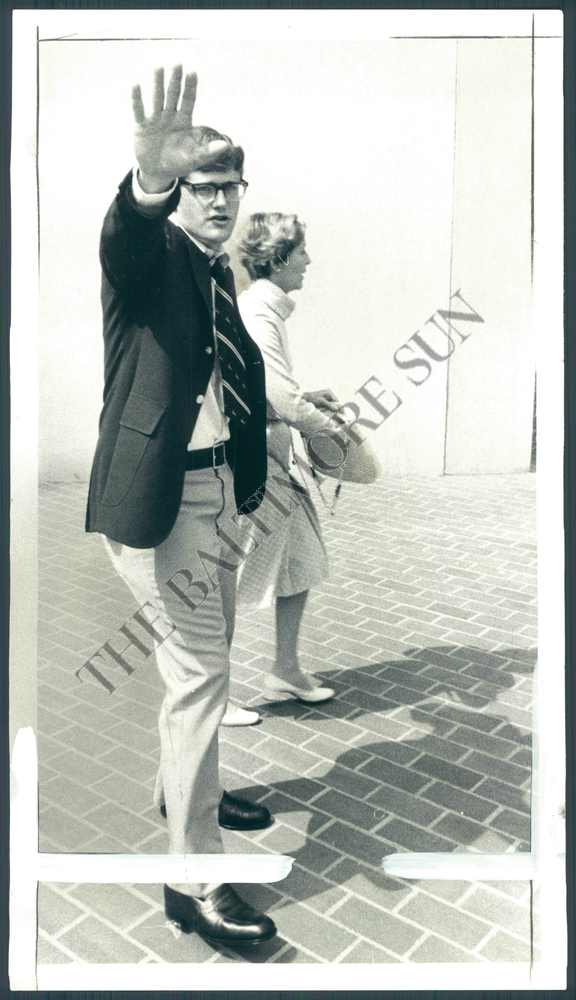
Overcome by curiosity, I had to know if this was the same person — and if the church knew. I emailed the spokeswoman for the Arlington, Va., bishop’s office to ask. I wrote that I was a former parishioner. Although I am also an occasional freelance journalist, I wasn’t digging for a story at that point. I was looking for answers from my bishop — I am a Catholic parishioner in the Arlington diocese, at St. Mary’s in Alexandria.
I continued to pore over the details of Aitcheson’s case throughout the weekend: In 1982, a federal judge ordered him to pay $23,000 to Phillip and Barbara Butler, and $1,500 apiece to two Jewish groups, for burning crosses on their property in what the judge called “a personal campaign of terror.” The Butlers had been the fifth black family to move into the Maryland subdivision of College Park Woods, a predominantly white neighborhood at the time, when Aitcheson — who lived in a different Maryland county — erected a burning cross on their lawn. President Ronald Reagan read about the case in The Post and was so moved by the Butlers’ story that he went to visit them personally.
The Saturday morning after I sent my email, an official from the diocese emailed me back to say they would look into it; he asked if I was a journalist. By now, I realized that there was no question of Aitcheson being a different person and that I had clumsily stumbled into a real story. Yes, I said: I was a reporter in addition to being a former parishioner.
I called Phillip Butler, of the 1982 lawsuit against Aitcheson, and asked him if he had ever received any money or an apology. The answer was no — the family had never seen or heard from Aitcheson again. I explained how I had come upon the story. Butler, who is Catholic himself, was surprised to hear that Aitcheson had become a priest. Why hadn’t Butler pressed to receive the money? He told me he recalled that Aitcheson’s father had been something of a bigwig in Howard County and they didn’t imagine they would have much luck pressing it. They were satisfied with Reagan’s visit, which he said they “still cherish.” At the time, that was closure enough for them. (The University of Maryland Hillel, the first of the Jewish groups in the settlement, also told me that its rabbi at the time, Bob Saks, could not recall ever receiving a payment. Rabbi Mendel Abrams of the Beth Torah Congregation, the second group, said he had not received a payment or heard from the diocese as of Thursday.)
If that was enough for the Butlers, maybe it should have been enough for me, too. But I also wondered how a priest, a public representative of the church, could take such a position of influence without even privately apologizing for his sins to those he had harmed. Perhaps he couldn’t afford $23,000 at the time of his ordination, but I can’t believe he could never spare a phone call or a letter to ask forgiveness. As a Catholic, I was brought up to believe in God’s mercy — but my faith also teaches the necessity of penance, atonement, justice and paying your dues.
On Monday afternoon, the bishop’s office released the op-ed from Aitcheson, addressing (rather vaguely) his past, along with an announcement that he had requested to step down for now. Neither the editorial nor the accompanying news release addressed whether the church previously knew about his past or, if so, why church leaders had not asked him to apologize to the Butler family or pay his debt. The Arlington bishop’s office portrayed his disclosure, titled “Moving from hate to love with God’s grace,” as a spontaneous act, connected only to his private reflections on Charlottesville. “Our actions have consequences,” he wrote. So why hadn’t he faced them?
The Diocese of Reno, where Aitcheson was made a priest in 1988, informed me via email that while Aitcheson had “admitted” to officials there his involvement in the KKK, he had never made the church aware of the 1982 lawsuit and his debt. I wondered how such a large omission could really be considered “admitting” his past involvement. The Arlington diocese eventually released a similar statement about what it had known.
On Wednesday, the Butler family gave a news conference. Their attorney said that, while the diocese had now offered to set up a meeting for Aitcheson to apologize to the Butlers, they were unsure about how to proceed. They want him to finally reveal the names of the other Klan members who helped victimize them and who were never brought to justice. After the news conference, the Arlington diocese released another statement, saying that “a freelancer reporter, who introduced herself as a parishioner,” had contacted officials about Aitcheson’s past, prompting the disclosure.
I felt — and still feel — confused and conflicted about my role in this. A few nights into my investigation, I discovered yet another ugly surprise about someone from my past: An old acquaintance had marched in the white nationalist tiki torch parade at the University of Virginia, side by side with the young men shouting Nazi slogans.
I thought back to an evening several years ago, spent with this person and some mutual friends. After a few too many glasses of wine, he and another friend began to sing the unofficial anthem of the Confederacy — “Dixie.” I sang along, mangling the words a bit, but as a Virginian, it was a song I’d heard many times before.
Oh, I wish I was in the land of cotton,
Old times there are not forgotten.
Look away, look away, look away, Dixie land!
It was the second time I had thought about that familiar old song in recent days, and this time it made my stomach churn. As I had searched through every article I could find naming William Aitcheson, I came upon a 2004 article in Fredericksburg, Va.’s Free Lance-Star. Aitcheson was still my pastor then. He had presided over a memorial service for the Confederate dead, where he read “The Conquered Banner,” a popular post-Civil War poem composed by a Catholic priest who had been a chaplain for the Confederate army. Then, the Lance-Star reported, Aitcheson turned to the crowd and said, “Let’s sing the old national anthem.” He led them all in song.
I wish I was in Dixie, hooray! Hooray!
In Dixie land I’ll take my stand,
to live and die in Dixie.
Away, away, away down south in Dixie!
Away, away, away down south in Dixie!
Twitter: @mtksantos
Monday, August 07, 2017
You call this a worldview? Or, How To Bring Hell To Earth Without Really Trying.
Remember the good old days when the Vatican told Catholics which books, movies, and plays could easily lead you to Hell?
Where did Steve Bannon get his worldview? - Washington's other other newspaper -
by Neil Howe
Neil Howe is the author, along with William Strauss, of “Generations,” “The Fourth Turning” and “Millennials Rising.”
I'll save you the time and the brain cells, kiddies. This nonsense looks like the same gobbledygook peddled by Marx in the 19th Century and regurgitated by Francis Fukuyama in the late 20th: History is a Tilt-A-Whirl and we can't get off. Yeah, well Hell is full of circles (See The Inferno by Dante Alighieri.) and ain't nobody ever getting out of there.
The headlines this month have been alarming. “Steve Bannon’s obsession with a dark theory of history should be worrisome” (Business Insider). “Steve Bannon Believes The Apocalypse Is Coming And War Is Inevitable” (the Huffington Post). “Steve Bannon Wants To Start World War III” (the Nation). A common thread in these media reports is that President Trump’s chief strategist is an avid reader and that the book that most inspires his worldview is “The Fourth Turning: An American Prophecy.”
I wrote that book with William Strauss back in 1997. It is true that Bannon is enthralled by it. In 2010, he released a documentary, “Generation Zero,” that is structured around our theory that history in America (and by extension, most other modern societies) unfolds in a recurring cycle of four-generation-long eras. While this cycle does include a time of civic and political crisis — a Fourth Turning, in our parlance — the reporting on the book has been absurdly apocalyptic.
I don’t know Bannon well. I have worked with him on several film projects, including “Generation Zero,” over the years. I’ve been impressed by his cultural savvy. His politics, while unusual, never struck me as offensive. I was surprised when he took over the leadership of Breitbart and promoted the views espoused on that site. Like many people, I first learned about the alt-right (a far-right movement with links to Breitbart and a loosely defined white-nationalist agenda) from the mainstream media. Strauss, who died in 2007, and I never told Bannon what to say or think. But we did perhaps provide him with an insight — that populism, nationalism and state-run authoritarianism would soon be on the rise, not just in America but around the world.
Because we never attempted to write a political manifesto, we were surprised by the book’s popularity among certain crusaders on both the left and the right. When “The Fourth Turning” came out, our biggest partisan fans were Democrats, who saw in our description of an emerging “Millennial generation” (a term we coined) the sort of community-minded optimists who would pull America toward progressive ideals. Yet we’ve also had conservative fans, who were drawn to another lesson: that the new era would probably see the successful joining of left-wing economics with right-wing social values.
INSTANT TRANSLATION: "The fascist left and the fascist right will finally realize they have more in common than they previously thought, form a one-party State and start shooting.
Beyond ideology, I think there’s another reason for the rising interest in our book. We reject the deep premise of modern Western historians that social time is either linear (continuous progress or decline) or chaotic (too complex to reveal any direction). Instead we adopt the insight of nearly all traditional societies: that social time is a recurring cycle in which events become meaningful only to the extent that they are what philosopher Mircea Eliade calls “reenactments.” In cyclical space, once you strip away the extraneous accidents and technology, you are left with only a limited number of social moods, which tend to recur in a fixed order.
Along this cycle, we can identify four “turnings” that each last about 20 years — the length of a generation. Think of these as recurring seasons, starting with spring and ending with winter. In every turning, a new generation is born and each older generation ages into its next phase of life.
The cycle begins with the First Turning, a “High” which comes after a crisis era. In a High, institutions are strong and individualism is weak. Society is confident about where it wants to go collectively, even if many feel stifled by the prevailing conformity. Many Americans alive today can recall the post-World War II American High (historian William O’Neill’s term), coinciding with the Truman, Eisenhower and Kennedy presidencies. Earlier examples are the post-Civil War Victorian High of industrial growth and stable families, and the post-Constitution High of Democratic Republicanism and Era of Good Feelings.
The Second Turning is an “Awakening,” when institutions are attacked in the name of higher principles and deeper values. Just when society is hitting its high tide of public progress, people suddenly tire of all the social discipline and want to recapture a sense of personal authenticity. Salvation by faith, not works, is the youth rallying cry. One such era was the Consciousness Revolution of the late 1960s and 1970s. Some historians call this America’s Fourth or Fifth Great Awakening, depending on whether they start the count in the 17th century with John Winthrop or the 18th century with Jonathan Edwards.
The Third Turning is an “Unraveling,” in many ways the opposite of the High. Institutions are weak and distrusted, while individualism is strong and flourishing. Third Turning decades such as the 1990s, the 1920s and the 1850s are notorious for their cynicism, bad manners and weak civic authority. Government typically shrinks, and speculative manias, when they occur, are delirious.
Finally, the Fourth Turning is a “Crisis” period. This is when our institutional life is reconstructed from the ground up, always in response to a perceived threat to the nation’s very survival. If history does not produce such an urgent threat, Fourth Turning leaders will invariably find one — and may even fabricate one — to mobilize collective action. Civic authority revives, and people and groups begin to pitch in as participants in a larger community. As these Promethean bursts of civic effort reach their resolution, Fourth Turnings refresh and redefine our national identity. The years 1945, 1865 and 1794 all capped eras constituting new “founding moments” in American history.
Just as a Second Turning reshapes our inner world (of values, culture and religion), a Fourth Turning reshapes our outer world (of politics, economy and empire).
In our paradigm, one can look ahead and suggest that a coming time period — say, a certain decade — will resemble, in its essential human dynamic, a time period in the past. In “The Fourth Turning,” we predicted that, starting around 2005, America would probably experience a “Great Devaluation” in financial markets, a catalyst that would mark America’s entry into an era whose first decade would likely parallel the 1930s.
Reflecting on the decade we’ve just lived through, we can probably agree that the 1930s parallel works well. In the economy, both decades played out in the shadow of a global financial crash, and were characterized by slow and disappointing economic growth and chronic underemployment of labor and capital. Both saw tepid investment, deflation fears, growing inequality and the inability of central bankers to rekindle consumption.
In geopolitics, we’ve witnessed the rise of isolationism, nationalism and right-wing populism across the globe. Geostrategist Ian Bremmer says we now live in a “G-Zero” world, where it’s every nation for itself. This story echoes the 1930s, which witnessed the waning authority of great-power alliances and a new willingness by authoritarian regimes to act with terrifying impunity.
In social trends, the two decades also show parallels: falling rates of fertility and homeownership, the rise of multi-generational households, the spread of localism and community identification, a dramatic decline in youth violence (a fact that apparently has eluded the president), and a blanding of pop youth culture. Above all, we sense a growing desire among voters around the world for leaders to assert greater authority and deliver deeds rather than process, results rather than abstractions.
We live in an increasingly volatile and primal era, in which history is speeding up and liberal democracy is weakening. As Vladimir Lenin wrote, “In some decades, nothing happens; in some weeks, decades happen.” Get ready for the creative destruction of public institutions, something every society periodically requires to clear out what is obsolete, ossified and dysfunctional — and to tilt the playing field of wealth and power away from the old and back to the young. Forests need periodic fires; rivers need periodic floods. Societies, too. That’s the price we must pay for a new golden age.
If we look at the broader rhythms of history, we have reason to be heartened, not discouraged, by these trends. Anglo-American history over the past several centuries has experienced civic crises in a fairly regular cycle, about every 80 or 90 years, or roughly the length of a long human life. This pattern reveals itself in the intervals separating the colonial Glorious Revolution, the American Revolution, the Civil War, and the Great Depression and World War II. Fast-forward the length of a long human life from the 1930s, and we end up where we are today.
America entered a new Fourth Turning in 2008. It is likely to last until around 2030. Our paradigm suggests that current trends will deepen as we move toward the halfway point.
Further adverse events, possibly another financial crisis or a major armed conflict, will galvanize public opinion and mobilize leaders to take more decisive action. Rising regionalism and nationalism around the world could lead to the fragmentation of major political entities (perhaps the European Union) and the outbreak of hostilities (perhaps in the South China Sea, the Korean Peninsula, the Baltic states or the Persian Gulf).
Despite a new tilt toward isolationism, the United States could find itself at war. I certainly do not hope for war. I simply make a sobering observation: Every total war in U.S. history has occurred during a Fourth Turning, and no Fourth Turning has yet unfolded without one. America’s objectives in such a war are likely to be defined very broadly.
At the end of the 2020s, the Fourth Turning crisis era will climax and draw to a close. Settlements will be negotiated, treaties will be signed, new borders will be drawn, and perhaps (as in the late 1940s) a new durable world order will be created. Perhaps as well, by the early 2030s, we will enter a new First Turning: Young families will rejoice, fertility will rebound, economic equality will rise, a new middle class will emerge, public investment will grow into a new 21st-century infrastructure, and ordered prosperity will recommence.
During the next First Turning, potentially the next “American High,” millennials will move into national leadership and showcase their optimism, smarts, credentials and confidence. Sometime in the late 2030s, the first millennial will be voted into the White House, prompting talk of a new Camelot moment. Let a few more years pass, and those organization-minded millennials may face a passionate and utterly unexpected onslaught from a new crop of youth.
Welcome to the next Awakening. The cycle of history keeps turning, inexorably.
TheChurchMilitant: Sometimes anti-social, but always anti-fascist since 2005.
About Me
- TheChurchMilitant
- First of all, the word is SEX, not GENDER. If you are ever tempted to use the word GENDER, don't. The word is SEX! SEX! SEX! SEX! For example: "My sex is male." is correct. "My gender is male." means nothing. Look it up. What kind of sick neo-Puritan nonsense is this? Idiot left-fascists, get your blood-soaked paws off the English language. Hence I am choosing "male" under protest.