In his General Audience of 14 July 1982, the Holy Father continued his catechesis on Theology of the Body. He further examined St. Paul's teaching on the complementarity of continence and marriage, both vocations having in view the future life.
The Kingdom of God, Not the World, Is Man's Eternal Destiny
At the general audience in St Peter's Square late Wednesday afternoon,14 July, the Holy Father continued his reflections on St Paul's teaching on marriage and voluntary continence, in which is contained the theology of a great expectation.
1. During our previous considerations in analyzing the seventh chapter of the First Letter to the Corinthians, we have been striving to gather together and understand the teachings and advice that St. Paul gives to the recipients of his letter about the questions concerning marriage and voluntary continence (or abstention from marriage). Declaring that one who chooses marriage does well and one who chooses virginity does better, the Apostle refers to the passing away of the world—that is, of everything that is temporal.
It is easy to see that the argument from the perishable and transient nature of what is temporal speaks with much greater force in this case than reference to the reality of the other world. The Apostle here expresses himself with some difficulty. Nevertheless, we can agree that at the basis of the Pauline interpretation of the subject of marriage-virginity, there is found not so much the very metaphysics of accidental being (therefore fleeting), but rather the theology of a great expectation, of which Paul was a fervent champion. The world is not man's eternal destiny, but the kingdom of God. Man cannot become too attached to the goods that are linked to a perishable world.
2. Marriage also is tied in with the form of this world which is passing away. In a certain sense, here we are very close to the perspective Christ opened in his statement about the future resurrection (cf. Mt 22:23-32; Mk 12:18-27; Lk 20:27-40). Therefore according to Paul's teaching, the Christian must live marriage from the point of view of his definitive vocation. Marriage is tied in with the form of this world which is passing away and therefore in a certain sense imposes the necessity of being locked in this transiency. On the other hand, abstention from marriage could be said to be free of this necessity. For this reason the Apostle declares that one who chooses continence does better. Although his argumentation follows this course, nevertheless he decidedly stresses above all (as we have already seen) the question of "pleasing the Lord" and "being anxious about the affairs of the Lord."
3. It can be admitted that the same reasons speak in favor of what the Apostle advises women who are widowed: "A wife is bound to her husband as long as he lives. If the husband dies, she is free to be married to whom she wishes, only in the Lord. But in my judgment she is happier if she remains as she is. And I think that I have the Spirit of God" (1 Cor 7:39-40). Therefore, she should remain a widow rather than contract a new marriage.
4. Through what we discover from a thoughtful reading of the Letter to the Corinthians, especially chapter seven, the whole realism of the Pauline theology of the body is revealed. In the letter the Apostle proclaims: "Your body is a temple of the Holy Spirit who is in you" (1 Cor 6:19). Yet at the same time he is fully aware of the weakness and sinfulness to which man is subjected, precisely by reason of the concupiscence of the flesh.
However, this awareness in no way obscures for him the reality of God's gift. This is shared by those who abstain from marriage and also by those who take a wife or husband. In the seventh chapter of the First Letter to the Corinthians we find clear encouragement for abstention from marriage, the conviction that whoever decides on this abstention, does better. But we do not find any foundation for considering those who live in marriage as carnal and those who instead choose continence for religious motives as spiritual. In both the one and the other way of living—today we would say in one and the other vocation—the "gift" that each one receives from God is operative, that is, the grace that makes the body a "temple of the Holy Spirit." This gift remains, in virginity (in continence) as well as in marriage, if the person remains faithful to his gift and, according to his state, does not dishonor this temple of the Holy Spirit, which is his body.
5. In Paul's teaching, contained above all in the seventh chapter of the First Letter to the Corinthians, we find no introduction to what will later be called Manichaeism. The Apostle is fully aware that—insofar as continence for the sake of the kingdom of God is always worthy of recommendation—at the same time grace, that is, "one's own gift from God," also helps married couples. It helps them in that common life in which (according to the words of Gn 2:24) they are so closely united that they become one body. This carnal common life is therefore subject to the power of their own gift from God. The Apostle writes about it with the same realism that marks his whole reasoning in the seventh chapter of this letter: "The husband should give to his wife her conjugal rights, and likewise the wife to her husband. For the wife does not rule over her own body, but the husband does; likewise, the husband does not rule over his own body, but the wife does" (verses 3-4).
6. It can be said that these statements are a clear comment in the New Testament on the words scarcely recorded in the Book of Genesis (cf. Gn 2:24). Nevertheless, the words used here, especially the expressions "rights" and "does not rule," cannot be explained apart from the proper context of the marriage covenant, as we have tried to clarify in analyzing the texts of the Book of Genesis. We will attempt to do it even more fully when we speak about the sacramentality of marriage, drawing on the Letter to the Ephesians (cf. Eph 5:22-33). At the proper time it will be necessary to return to these significant expressions, which have passed from Paul's vocabulary into the whole theology of marriage.
7. For now we will continue to direct our attention to the other sentences in the same passage of the seventh chapter of the First Letter to the Corinthians, in which the Apostle addresses these words to married couples: "Do not refuse one another except perhaps by agreement for a season, that you may devote yourselves to prayer. But then come together again, lest Satan tempt you through lack of self-control. I say this by way of concession, not of command" (1 Cor 7:5-6). This is a very significant text, and it will perhaps be necessary to refer to it again in the context of our meditations on the other subjects.
In all of his argumentation about marriage and continence, the Apostle makes a clear distinction, as Christ does, between the commandment and the evangelical counsel. It is very significant that St. Paul feels the need to refer also to a "concession," as to an additional rule, above all precisely in reference to married couples and their mutual common life. St. Paul clearly says that conjugal common life and the voluntary and periodic abstinence by the couple must be the fruit of this gift of God which is their own. He says that the couple themselves, by knowingly cooperating with it, can maintain and strengthen that mutual personal bond and also that dignity conferred on the body by the fact that it is a "temple of the Holy Spirit who is in them" (1 Cor 6:19).
8. It seems that the Pauline rule of "concession" indicates the need to consider all that in some way corresponds to the very different subjectivity of the man and the woman. Everything in this subjectivity that is not only of a spiritual but also of a psychosomatic nature, all the subjective richness of man which, between his spiritual being and his corporeal, is expressed in the sensitivity whether for the man or for the woman—all this must remain under the influence of the gift that each one receives from God, a gift that is one's own.
As is evident, in the seventh chapter of the First Letter to the Corinthians, St. Paul interprets Christ's teaching about continence for the sake of the kingdom of heaven in that very pastoral way that is proper to him, not sparing on this occasion entirely personal accents. He interprets the teaching on continence and virginity along parallel lines with the doctrine on marriage. He keeps the realism that is proper to a pastor, and at the same time the proportions that we find in the Gospel, in the words of Christ himself.
9. In Paul's statement we can find again that fundamental structure containing the revealed doctrine about man, that even with his body he is destined for future life. This supporting structure is at the basis of all the Gospel teaching about continence for the sake of the kingdom of God (cf. Mt 19:12). But at the same time there also rests on it the definitive (eschatological) fulfillment of the Gospel doctrine on marriage (cf. Mt 22:30; Mk 12:25; Lk 20:36). These two dimensions of the human vocation are not opposed to each other, but are complementary. Both furnish a full answer to one of man's fundamental questions, the question about the significance of "being a body," that is, about the significance of masculinity and femininity, of being "in the body" a man or a woman.
10. What we usually define here as the theology of the body is shown to be something truly fundamental and constitutive for all anthropological hermeneutics. At the same time it is equally fundamental for ethics and for the theology of the human ethos. In each one of these fields we must listen attentively to the words of Christ, in which he recalled the beginning (cf. Mt 19:4) or the heart as the interior, and at the same time historical place of meeting with the concupiscence of the flesh. But we must also listen attentively to the words through which Christ recalled the resurrection in order to implant in the same restless heart of man the first seeds of the answer to the question about the significance of being flesh in the perspective of the other world.
Thursday, April 13, 2006
The Theology of the Body: 85. The Kingdom of God, Not the World, Is Man's Eternal Destiny

43 Years Later, Actress-Turned-Nun Dolores Hart Visits Hollywood
From ABC News:
Dolores Hart, who at age 24 startled the film world in 1962 by leaving a thriving screen career including two roles opposite Elvis Presley to become a nun, has returned to Hollywood for her first visit after 43 years in a monastery.
Now the Reverend Mother Dolores Hart and prioress of the cloistered community at Abbey of Regina Laudis in Connecticut, she has been renewing friendships from her studio years.
Lord, bless and protect the Reverend Mother and all the Brides of Christ.
Why? To spread awareness about a largely mysterious neurological disorder that afflicts countless Americans, including herself, called peripheral idiopathic neuropathy.
Last month, Hart testified at a congressional hearing in Washington, citing the need for research into a cause and cure for the painful and crippling disease.
Over a recent lunch at the Beverly Wilshire Hotel, Mother Dolores spoke of her ordeal with the disease. She also told of her long ambition to be an actress and what ended that phase of her life.
She seems in radiant health at 67, her cheeks smooth and rosy, her blue eyes clear. She wore traditional nun's attire, with a couple of additions: a green hand-knit sweater under the robe and a jaunty black beret.
In 1999, Hart underwent a root canal. The dentist suggested doing another root canal at the same time, and she agreed. Two days later, Hart awakened with searing pain.
"I couldn't eat," she recalled. "When I put my feet on the floor, I couldn't stand. My feet felt like they were on fire. I couldn't talk. I thought, 'This is ridiculous.' I couldn't understand what in the world was going on. A doctor said this would improve, but it kept getting worse."
For six months, she journeyed from doctor to doctor, yet none could figure out what was causing her pain. Finally, a New York specialist tried changing her medicine and she gradually was able to leave her wheelchair and resume a more normal life.
The luncheon conversation moved to her acting career, and she spoke fondly of that period in her life.
"From the age of 7, I never in my life wanted to be anything but an actress," Hart said. She was a strong-willed girl even at that age. When her parents divorced in Los Angeles but were constantly wrangling, she wrote a letter to her grandmother in Chicago asking to live with her. She was soon on a train to the Windy City alone a ticket pinned to her coat.
Hart's grandfather was a projectionist at a downtown movie palace and she often accompanied him to work. Her special job was to awaken him from naps every 12 minutes so he could change reels.
Years later, Hart was back in Los Angeles playing the lead in a school production of "Saint Joan" and an admirer asked where she had studied acting technique. She admitted that her only schooling came from analyzing actors' performances without sound, no less in the projection booth of a Chicago theater.
A friend notified the studios of a remarkable young actress in "Saint Joan," and Hal Wallis, an independent producer at Paramount, sent a scout to check her out. He ended up recommending Hart, and a film test and contract soon followed.
She made her screen debut as Elvis' love interest in 1957's "Loving You," his first starring role.
"I had no idea who Elvis Presley was," she admitted. "When I first met him, he was just a charming and very simple young boy with longer sideburns than most. He couldn't have been more gracious. He jumped to his feet and said, 'Good afternoon, Miss Dolores.' He and Gary Cooper were the only ones in Hollywood who called me that."
Hart made another film with Presley, "King Creole," and appeared in prestigious productions such as "Wild is the Wind," with Anna Magnani and Anthony Quinn, and "Lonelyhearts," with Montgomery Clift and Myrna Loy.
"I was never a star," she insisted. "Being a star means your name is above the title. Mine never was."
A clever talker, she was a regular on the talk-show circuit and was a fan-magazine favorite.
"I really loved the acting life," she said. But when she was appearing in the Western "The Plunderers" with Jeff Chandler in 1959, she looked in the mirror and heard a voice saying: "You're really enjoying this, but you're not going to do this much longer." She was puzzled but continued working.
After nine months in New York with the play "The Pleasure of His Company," she complained to a friend that she was weary. The friend recommended a retreat at a Connecticut monastery. Hart was hesitant but decided to go. She found a remarkable peace. She continued returning to the monastery twice a year.
Back in Hollywood, she became engaged to Los Angeles businessman Don Robinson. One night, she related, he asked her, "Do you love me?" She answered, "Yes, I love you." He asked her again. Same answer. "It doesn't sound right," he said. The engagement was canceled, and in December 1962, she flew to Connecticut, never to return until now.
Mother Dolores is proud of one element of her Hollywood life: being invited to become a member of the Academy of Motion Picture Arts and Sciences. She is still a member and votes each year for the Academy Awards.
Does that mean she sees all the nominees, no matter how bawdy?
"Yes, I do," she replied with a smile. "If you're a Benedictine, as I am, you're supposed to be capable of integrating anything."
The difference is a Benedictine nun knows the difference between good and evil.
Has anyone seen The Great Cartoon War of '06 recently?
I can't understand it.
Various Crusaders and ne'er-do-wells (including Your Humble Servant) published cartoons featuring a noted humanitarian and false prophet named Muhammed who made up his own religion a couple of years ago. Ol' Mr. M's followers were so outraged, they burned, pillaged, and murdered innocent civilians in several places around the globe.
I have been busy, but not so busy as to fail to notice new reports from the various fronts in this Great Cartoon War of '06. What happened?
I would think that if the world's billion-odd mohammedans were really that pissed off and our crime against their religion was that egregious, they would be slaughtering everyone who stood between them and those pesky Danish cartoonists.
But, no, that isn't happening. My guess is the ignorant and enslaved mohammedan masses were once again whipped into a murderous frenzy by their so-called religious leaders for political (Funny how all the bad stuff seems to start there, huh?) purposes.
Why even bother giving them bread and circuses when you can fool them into believing they are doing their god's will?
You can really smell the brimstone...
From the Villanova University front of the Counter-Revolution:
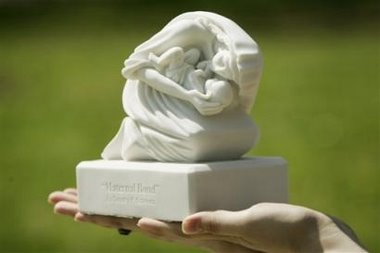 ABOVE: The statue in question. Note its in-your-face patriarchal hatred of womyn.
I put the quotation marks around the word controversial in the link below. If the antique media can print "victims of abortion" (see Jill Porter's apologia for child murder below) why can't I do a little editorializing?
Villanova board to rule on "controversial" statue
Villanova University Board of Trustees members are expected to vote today on whether to approve a controversial statue that members of the student anti-abortion group Villanovans for Life want to erect on the south campus trail of the Catholic university near Ithan Avenue.
Please pray that the Lord will give them the courage to battle the spirt of our benighted age.
Members of the group raised $20,000 for "Maternal Bond" --which features a figure resembling the Blessed Mother bent over and embracing a child -- in only three weeks, said monument coordinator Lauren Homans. She noted that the bulk of the funds were contributed by 1959 Villanova University graduate Joseph McCullen.
Homans said the bronze statue by Canadian sculptor Timothy P. Schmaltz is meant to create "an awareness that there are people who have been hurt by abortion and are in need of healing."
The statue has created some controversy on campus, although Homans said she has heard of only about 10 students who have protested the monument via letters to the campus newspaper or e-mails to Villanovans for Life.
On Monday, the group’s Web site indicated the statue had already been approved by the university board of trustees.
"I was under the impression it was approved, but the administration said it wasn’t," Homans said Monday.
She is optimistic that it will be approved.
Villanova University spokeswoman Barbara Clement said the statue is one of several items on the agenda for the board of trustees, who will meet today starting around 8 a.m. in the Villanova conference center.
"Neither the sculpture nor the area where it is supposed to be erected has been approved by the board of trustees," Clement said Monday.
Daily News: Jill Porter - The right to do the wrong thing
Basically, this dark-hearted and murderous left-fascist's argument goes like this: "Sure, a Catholic school has the right to protest abortion 'cause this is America, BUT they can't because I don't agree with it."
Pope Benedict XVI Honors Priest Shot to Death in Turkey
Today we remember Christ's gift of the Sacrament of Holy Orders, which has been handed down to us through His apostles. Please pray that more good men will answer God's call to the priestly vocation. Please pray that all our current priests will be faithful instruments of His Will. And please pray for the souls of all deceased priests, especially Father Andrea Santoro.
Pope Benedict XVI recalled the sacrifice of a cleric slain in Turkey on Thursday as he celebrated a Holy Week Mass dedicated to priests.
In his homily, Benedict read a letter written by the Rev. Andrea Santoro in which the Italian prelate spoke of his willingness to offer his own body for the sake of preaching Catholicism in largely Muslim Turkey.
Santoro, 60, was shot and killed Feb. 5 while he prayed in his parish in the Black Sea city of Trabzon. Witnesses said the killer, a 16-year-old boy, screamed "Allahu Akbar," Arabic for "God is great," before firing two bullets into Santoro's back.
Benedict quoted Santoro as saying in his letter that he had chosen to live in Turkey to be among its people, "lending" his body to Christ to do so.
"One becomes capable of salvation only by offering one's own body," Santoro wrote.
Now that is a priest.
Santoro's slaying occurred at the height of unrest in the Muslim world over caricatures of the Prophet Muhammad published in Europe. Top church officials have called Santoro a martyr.
Benedict's homily came during a Mass dedicated to priests who during Holy Week recall the promises they made when they were ordained. The Mass, celebrated in St. Peter's Basilica, came hours before another service in which Benedict was to wash the feet of 12 men to commemorate Jesus' Last Supper with his 12 apostles.
Pope John Paul II traditionally wrote a separate letter to priests that coincided with the Holy Thursday Mass, addressing subjects such as celibacy. Benedict didn't follow that tradition, but he used his homily to remind priests of their promises to serve God.
He referred to the rites of ordination in which a bishop lays his hands on the priest, as well as the oil used in the sacrament to anoint the priests' hands. During Thursday's Mass, huge silver vats of oil were blessed.
"Let us put our hands today again at (God's) disposition and pray that he takes our hands to guide us," Benedict said. "Let his hand take ours so we won't sink, but will serve life which is stronger than death, and love which is stronger than hatred."
Holy Thursday and Good Friday services, in which Benedict will preside over the re-enactment of Jesus' suffering, crucifixion and death, are among the most solemn on the church calendar, and come in advance of Easter Sunday, when the faithful celebrate Christ's resurrection from the dead.
Saint of the Day and daily Mass readings.
Today is Holy Thursday.
Today is also the Feast of Pope St. Martin I, who died in exile in 656, a martyr who defended The Church against heresy and secular power. Pray for us, all you angels and saints.
Chrism Mass
Today's first reading is Isaias 61:1-3, 6, 8-9.
Today's Responsorial Psalm is Psalms 89:21-22, 25, 27.
Today's second reading is Apocalypse 1:5-8.
Today's Gospel reading is Luke 4:16-21.
Evening Mass of the Lord's Supper
First Reading: Exodus 12:1-8, 11-14
Responsorial Psalm: Psalms 116:12-13, 15-16, 17-18
Second Reading: First Corinthians 11:23-26
Gospel: John 13:1-15
[Links to the readings will be from the NAB until I can find another chapter and verse searchable Douay-Rheims Bible on-line.]
Everyday links:
The Blessed Virgin Mary
The Rosary
Our Mother of Perpetual Help
Prayers from EWTN
National Coalition of Clergy and Laity (dedicated to action for a genuine Catholic Restoration)
The Catholic Calendar Page for Today
Just in case you are wondering what exactly Catholics believe, here is
The Apostles Creed
I believe in God, the Father Almighty, Creator of Heaven and earth; and in Jesus Christ, His only Son Our Lord, Who was conceived by the Holy Spirit, born of the Virgin Mary, suffered under Pontius Pilate, was crucified, died, and was buried.He descended into Hell; the third day He rose again from the dead; He ascended into Heaven, and sitteth at the right hand of God, the Father almighty; from thence He shall come to judge the living and the dead.I believe in the Holy Spirit, the holy Catholic Church, the communion of saints, the forgiveness of sins, the resurrection of the body and life everlasting. Amen.
Memorare
Remember, O most gracious Virgin Mary, that never was it known that any one who fled to thy protection, implored thy help or sought thy intercession,was left unaided.Inspired with this confidence, I fly unto thee, O Virgin of virgins my Mother; to thee do I come, before thee I stand, sinful and sorrowful; O Mother of the Word Incarnate, despise not my petitions, but in thy clemency hear and answer me. Amen.
St. Joseph, her most chaste spouse, pray for us.
Prayer to St. Anthony, Martyr of Desire
Dear St. Anthony, you became a Franciscan with the hope of shedding your blood for Christ. In God's plan for you, your thirst for martyrdom was never to be satisfied. St. Anthony, Martyr of Desire, pray that I may become less afraid to stand up and be counted as a follower of the Lord Jesus. Intercede also for my other intentions. (Name them.)
Prayer To Saint Michael The Archangel
St. Michael the Archangel, defend us in battle, be our defense against the wickedness and snares of the devil; may God rebuke him, we humbly pray, and do thou O Prince of the heavenly hosts, by the divine power, thrust into hell Satan and all the evil spirits who prowl about the world seeking the ruin of souls. Amen.
Prayer to End Abortion
Lord God, I thank You today for the gift of my life, and for the lives of all my brothers and sisters. I know there is nothing that destroys more life than abortion, yet I rejoice that you have conquered death by the resurrection of Your Son. I am ready to do my part to end abortion. Today I commit myself never to be silent, never to be passive, and never to be forgetful of the unborn. I commit myself to be active in the pro-life movement, and never stop defending life until all my brothers and sisters are protected and our nation once again becomes a nation with liberty and justice, not just for some, but for all. Through Christ our Lord. Amen.
Wednesday, April 12, 2006
It Takes A Village To Staff A Gestapo Unit Update.
Senatrix Hitlery Schickelgruber (N-NY) gives hard-stolen money to noted Pennsylvania womb-nazi Bob Casey. Forces of Progress, (Ta-da!) where are you when we need you most? Can no one stop this anti-womyn cow?
Hillary Clinton raises money for Pa. candidate Casey
Sen. Hillary Clinton headlined a fundraiser Tuesday for Democratic Senate candidate Bob Casey.
Casey, the state treasurer, has been ahead of Sen. Rick Santorum, R-Pa., for months in the polls, but Santorum ended 2005 with more than twice as much cash on hand.
The event was at Chicago's Palmer House Hilton. Clinton, D-N.Y., was here to deliver a speech Tuesday night to the Economic Club of Chicago.
Larry Smar, a Casey campaign spokesman, said Tuesday an estimate of how much the event raised was not available.
The National Organization for Women has criticized Clinton, who supports abortion rights, before for contributing $10,000 from her political action committee to Casey. Like Santorum, Casey is anti-abortion.
A noted 2008 Repansycan presidential hopeful is full of love and sunshine. And gumdrops. Never forget the gumdrops.
Sadly, America may deserve a man like Mitt (huh?) Romney.
WFSB 3: Romney's health care vetoes
Massachusetts Gov. Mitt Romney vetoed eight sections of the historic health care bill he signed into law Wednesday. Lawmakers have pledged to override any proposed changes.
NBC 10: Romney Signs Sweeping Health Care Bill
Gov. Mitt Romney has signed into law a landmark bill designed to guarantee virtually all Massachusetts residents have health insurance.
The Theology of the Body: 84. Everyone Has His Own Gift from God, Suited to His Vocation
In his General Audience of 7 July 1982, the Holy Father continued his catechesis on Theology of the Body, by further examination of St. Paul's statement that it is better to choose continence than to marry. While the gift of continence allows an undivided love for God, the grace of marriage is a true gift, suited to that state in life.
Everyone Has His Own Gift from God, Suited to His Vocation
At the general audience on Wednesday, 7 July, Pope John Paul continued his reflections on St Paul's reasons for stating that he who marries does "well", but he who refrains from marriage for the sake of the Kingdom of God does "better".
1. During last Wednesday's meeting, we tried to investigate the reasoning St. Paul uses in his First Letter to the Corinthians to convince them that whoever chooses marriage does well, while whoever chooses virginity (or continence according to the spirit of the evangelical counsel) does better (cf. 1 Cor 7:38). Continuing this meditation today, let us remember that according to Paul, "the unmarried person is anxious...how to please the Lord" (1 Cor 7:32).
"To please the Lord" has love as its foundation. This foundation arises from a further comparison. The unmarried person is anxious about how to please God, while the married man is anxious also about how to please his wife. In a certain sense, the spousal character of "continence for the sake of the kingdom of God" is apparent here. Man always tries to please the person he loves. Therefore, "to please God" is not without this character that distinguishes the interpersonal relationship between spouses. On the one hand, it is an effort of the man who is inclined toward God and seeks the way to please him, that is, to actively express his love. On the other hand, an approval by God corresponds to this aspiration. By accepting man's efforts, God crowns his own work by giving a new grace. Right from the beginning, this aspiration has been his gift. "Being anxious how to please God" is therefore a contribution of man in the continual dialogue of salvation that God has begun. Evidently, every Christian who lives his faith takes part in this dialogue.
2. However, Paul observes that the man who is bound by the marriage bond "is divided" (1 Cor 7:34) by reason of his family obligations (cf. 1 Cor 7:34). From this remark it apparently follows that the unmarried person would be characterized by an interior integration, by a unification that would allow him to dedicate himself completely to the service of the kingdom of God in all its dimensions. This attitude presupposes abstention from marriage, exclusively for the sake of the kingdom of God, and a life uniquely directed to this goal. In a different way the "division" can also sneak into the life of an unmarried person. Being deprived of married life on the one hand, and on the other, of a clear goal for which he should renounce marriage, he could find himself faced with a certain emptiness.
3. The Apostle seems to know all this very well. He takes pains to specify that he does not want to lay any restraint on one whom he advises not to marry, but he gives this advice to direct him to what is worthy and keeps him united to the Lord without any distractions (cf. 1 Cor 7:35). These words bring to mind what Christ said to his apostles during the Last Supper, according to the Gospel of Luke: "You are those who have continued with me in my trials [literally, 'in temptations'], and I prepare a kingdom for you, as the Father has prepared for me" (Lk 22:28-29). The unmarried person, "being united to the Lord," can be certain that his difficulties will be met with understanding: "For we do not have a high priest who is unable to sympathize with our weaknesses, but one who in every respect has been tempted as we are, yet without sinning" (Heb 4:15). This allows the unmarried person not so much to immerse himself exclusively in possible personal problems, but rather to include them in the great stream of the sufferings of Christ and of his Body, the Church.
4. The Apostle shows how one can be "united to the Lord": what can be attained by aspiring to a constant remaining with him, to a rejoicing in his presence (eupáredron), without letting oneself be distracted by nonessential things (aperispástos) (cf. 1 Cor 7:35).
Paul explains this thought even more clearly when he speaks of the situation of the married woman and of one who has chosen virginity or is widowed. While the married woman must be anxious about "how to please her husband," the unmarried woman "is anxious about the affairs of the Lord, in order to be holy in body and spirit" (1 Cor 7:34).
5. In order to grasp adequately the whole depth of Paul's thought, we must note that according to the biblical concept, holiness is a state rather than an action. It has first of all an ontological character and then also a moral one. Especially in the Old Testament it is a separation from what is not subject to God's influence, from what is profane, in order to belong exclusively to God. Holiness in body and spirit, therefore, signifies also the sacredness of virginity or celibacy accepted for the sake of the kingdom of God. At the same time, what is offered to God must be distinguished by moral purity and therefore presupposes behavior "without spot or wrinkle," "holy and immaculate," according to the virginal example of the Church in the presence of Christ (Eph 5:27).
In this chapter of his First Letter to the Corinthians, the Apostle touches upon the problems of marriage and celibacy or virginity in a way that is deeply human and realistic, keeping in mind the mentality of his audience. Paul's reasoning is to a certain extent ad hominem. In the ambiance of his audience in Corinth, the new world, the new order of values that he proclaims must encounter another "world" and another order of values, different even from the one that the words addressed by Christ reached.
6. If Paul, with his teaching about marriage and continence, refers also to the transience of the world and human life in it, he certainly does so in reference to the ambiance which in a certain sense was programmed for the "use of the world." From this viewpoint, his appeal to "those who make use of the world" is significant, that they do it "as though they had no dealings with it" (1 Cor 7:31). From the immediate context it follows that in this ambiance, even marriage was understood as a way of "making use of the world"—differently from how it had been in the whole Jewish tradition (despite some perversions, which Jesus pointed out in his conversation with the Pharisees and in his Sermon on the Mount). Undoubtedly, all this explains the style of Paul's answer. The Apostle is well aware that by encouraging abstinence from marriage, at the same time he had to stress a way of understanding marriage that would be in conformity with the whole evangelical order of values. He had to do it with the greatest realism—that is, keeping before his eyes the ambiance to which he was addressing himself, the ideas and the ways of evaluating things that were predominant in it.
7. To men who lived in an ambiance where marriage was considered above all one of the ways of "making use of the world," Paul therefore expresses himself with significant words about virginity or celibacy (as we have seen), and also about marriage itself: "To unmarried persons and to widows I say, 'It is good for them to remain as I am. But if they cannot live in continence, let them marry. It is better to marry than to burn'" (1 Cor 7:8-9). Paul had already expressed almost the same idea: "Now concerning the matters about which you wrote, it is well for a man not to touch a woman. But because of the danger of incontinence, each man should have his own wife and each woman her own husband" (1 Cor 7:1-2).
8. Does the Apostle in his First Letter to the Corinthians perhaps look upon marriage exclusively from the viewpoint of a remedy for concupiscence, as used to be said in traditional theological language? The statements mentioned a little while ago would seem to verify this. However, right next to the statements quoted, we read a passage that leads us to see differently Paul's teaching as a whole, contained in the seventh chapter of his First letter to the Corinthians : "I wish that all were as I myself am, [he repeats his favorite argument for abstaining from marriage]—but each has his own special gift from God, one of one kind, and one of another" (1 Cor 7:7). Therefore even those who choose marriage and live in it receive a gift from God, his own gift, that is, the grace proper to this choice, to this way of living, to this state. The gift received by persons who live in marriage is different from the one received by persons who live in virginity and choose continence for the sake of the kingdom of God. All the same, it is a true gift from God, one's own gift, intended for concrete persons. It is specific, that is, suited to their vocation in life.
9. We can therefore say that while the Apostle, in his characterization of marriage on the human side (and perhaps still more in view of the local situation that prevailed in Corinth) strongly emphasizes the reason concerning concupiscence of the flesh, at the same time, with no less strength of conviction, he stresses also its sacramental and charismatic character. With the same clarity with which he sees man's situation in relation to concupiscence of the flesh, he sees also the action of grace in every person—in one who lives in marriage no less than in one who willingly chooses continence, keeping in mind that "the form of this world is passing away."
24's Body Count Update.
From Right Wing Nuthouse:
BODY COUNT
Two EMT’s make their last call. Two cops go down in the line of duty. Five thugs go down with Jack accounting for two of them. Carl shoulda stayed in bed.
JACK: 26
SHOW: 174
The ultimate Machiavellian, President Hilter, must die! He pretends to be Jimmy Carter, but he lives like Nixon on steroids. I hope his wife puts an ice pick in his ear. (Ha! Nobody has ice picks anymore. Silly me.)
ATTENTION! All you Anglo-Saxons out there trying to extort six bucks from us dagos for a tuna melt by calling it a "panini", CUT IT OUT!
 Ack! That's chicken you-know-what on a croissant! Get that French stuff outta here!
 That's better, even though it has turkey on it instead of capicola and Genoa salami. And that olive is a rather effete touch, don't you think?
Face the facts. You wouldn't know a panini if it took your daughter to the prom.
Take pride in your extremely limited culinary heritage and call it what it is, a freakin' tuna melt. And lower the price to a more reasonable $3.00.
(Humblest appy-polly loggies, kiddies. Old Fyodor had a bad lunch hour today.)
Joe Sobran takes the contrarian position on Mearsheimer and Walt's "anti-semitism".
The link above will take you to Joe's current on-line column. The archive is here. Not all of his past columns are available in the archive.
Joe is correct. As I have typed, Israel is not Judaism. Therefore, criticizing Israel does not make one a Jew hater. As a matter of fact, as Israel self-destructs, criticizing it may well be a sign of love and respect for our Jewish brothers. (See Orit's column here.)
On the other hand, Taranto is also correct. Anti-Israel sometimes may indeed equal anti-semitism. (I prefer the term "Jew-hatred". It catches the eye and the Arabs are a semitic people too. For example, if you hate Syrians, you are an anti-semite. Even if you are Jewish.)
The bottom line? The US must act in its national interest, properly understood, regardless of how that affects Israel.
If you think I'm being a weasel with that "properly understood" qualifier, let's try a little thought thingee:
Let us assume the UN has asked the US to send Norplant to Africa to sterilize millions of people of color. (Hard to imagine, no?) The State Department supports the plan, arguing it will buy us valuable good will Over There. The Forces of Progress (Ta-da!) in Congress like it as well because there will be fewer children Over There. The Vatican is against it, and, as a good Catholic, so am I.
Does this mean I am a traitor? Am I papist spy? Am I less of an American than Bill Gates or Ted Turner? Don't I want the kleptocrats that rule Africa to be our friends?
I am sure many (if not most) of my fellow Americans would answer yes to all of the above.
Let me just say my idea of what is best for America differs significantly from that of the Left, the Right, the realpolitik crowd, the Neocons, the isolationists, the Israel lobby, the Arab lobby, et ceterea. Hence "properly understood".
The Mother of All Bottom Lines, kiddies, is this: The only thing that ultimately matters is the salvation of souls.
From the humblest individual to the largest NGO and the most powerful of governments, (That would be ours, kiddies.) only salvation should matter. And don't kid yourself. We will all be judged on how we helped others save their souls as well as the condition of our own unique, immortal souls. (See St. Augustine on the Sermon on the Mount, here and here.)
(The WSJ's James Taranto on Mearsheimer and Walt is here, here, and here.)
Sorry, Joe. I am usually not so long-winded.
Things are getting messy. Before I address today’s headlines, let me offer my simple, comprehensive peace plan for the Middle East.
First, give Palestine back to the Brits. Then adopt a reverse Monroe Doctrine: the United States will stay out of the Eastern Hemisphere.
Think about it.
Okay, now to today’s headlines. Abdul Rahman, the Afghan gent who was sentenced to death for converting to Christianity, has been spared. Good thing we’ve brought democracy to Afghanistan, eh? President Bush says Islam is a “religion of peace” that has been “hijacked” by a few nuts. He would know.
One little question: Why didn’t the moderate majority of Muslims make a peep of protest when Rahman was sentenced to death? Maybe Islamic “moderation” is a little different from ours?
Over here, meanwhile, a couple of American professors, Stephen Walt of Harvard and John Mearsheimer of the University of Chicago, have published a long article on the Israel lobby, arguing that the state of Israel has been a huge liability for the United States. Having argued this myself for many years, I can tell them what to expect from their critics, if they don’t know already.
The two profs will hear the words anti-Semitism, Holocaust, genocide, Auschwitz, and so forth. Not that they’ll be directly accused of these things, but somehow the general idea will make itself felt.
For example, Bret Stephens, of the pro-Israel, pro-war Wall Street Journal, likens their article to an “anti-Semitic conspiracy theory,” using “every canard ever alleged of the Jews,” then adds scrupulously, “I do not mean to suggest that Messrs. Mearsheimer and Walt are themselves anti-Semitic. But ... what may not be anti-Semitic in intent may yet be anti-Semitic in effect. By giving aid and comfort to people who have no trouble substituting the word ‘Jews’ for ‘Israel lobby,’ the Mearsheimer-Walt article is anti-Semitic in effect.” Stephens adds his kiss-of-death clincher: “No wonder former Ku Klux Klansman David Duke was quick to endorse the article....”
“I do not mean to suggest ... But ... ” After but comes the insinuation. Analogy: “I do not mean to suggest that John Doe is himself a Soviet agent. But, well, just look at the people who are applauding his article! Draw your own conclusions.”
Mearsheimer and Walt aren’t facing a deadly tiger, but a Tasmanian devil — a nasty, filthy beast that won’t kill you, but will leave you with bites, scratches, and an infection. They are facing fanatical Jews who claim to speak for all Jews.
You can argue that Judaism too is a religion of peace — Jerusalem is the City of Peace — that has been hijacked by Zionist warmongers. But I guess that would be anti-Semitic. In effect, if not in intent, if you follow me.
The idea of the Chosen People returning to the Holy Land at last, after thousands of years, is an inspiring one. But the wrong people took it up and executed it in the wrong way — with a state that drove the natives out and created endless bitterness.
Still, I’ve come to believe that the United States, not Israel, is the chief culprit in the Middle East, which, to be sure, is a region overrun with culprits. We think of Christianity as a religion of peace, but imagine if, in this country, Methodists and Baptists were blowing up each others’ churches. That gives you a rough idea of the difficulty of pacifying Iraq after invading and disrupting it.
It’s a little late in the day to see Americans as “innocents abroad,” as I once did. The rest of the world no longer sees us as well-meaning oafs, seduced by the Zionists. It thinks we’re big boys now who ought to know what we’re doing and be held responsible. This is called “anti-Americanism,” which seems to be very much like, and closely related to, “anti-Semitism.”
Bush has tried to salvage his innocence by blaming “faulty intelligence,” but then continuing on the same course anyway. Attila the Hun also relied on intelligence: he never invaded without consulting his astrologer and being assured it was a slam-dunk. Apparently, judging by his successful record, his astrologer was more reliable than the CIA. So was Nancy Reagan’s. The lesson for Bush is obvious.
How can you tell the difference between a "global warming" Luddite and an acolyte of the neo-darwinian religion?
Ha! It's a trick question, kiddies. You cannot tell them apart. They both make up "scientific fact" in order to advance their totalitarian political agendas.
From Professor Richard Lindzen (at OpinionJournal) comes the chilling tale of the liars, frauds, bullies, and dimbulbs who tell you what to think.
Global-warming alarmists intimidate dissenting scientists into silence.
There have been repeated claims that this past year's hurricane activity was another sign of human-induced climate change. Everything from the heat wave in Paris to heavy snows in Buffalo has been blamed on people burning gasoline to fuel their cars, and coal and natural gas to heat, cool and electrify their homes. Yet how can a barely discernible, one-degree increase in the recorded global mean temperature since the late 19th century possibly gain public acceptance as the source of recent weather catastrophes? And how can it translate into unlikely claims about future catastrophes?
The answer has much to do with misunderstanding the science of climate, plus a willingness to debase climate science into a triangle of alarmism. Ambiguous scientific statements about climate are hyped by those with a vested interest in alarm, thus raising the political stakes for policy makers who provide funds for more science research to feed more alarm to increase the political stakes. After all, who puts money into science--whether for AIDS, or space, or climate--where there is nothing really alarming? Indeed, the success of climate alarmism can be counted in the increased federal spending on climate research from a few hundred million dollars pre-1990 to $1.7 billion today. It can also be seen in heightened spending on solar, wind, hydrogen, ethanol and clean coal technologies, as well as on other energy-investment decisions.
But there is a more sinister side to this feeding frenzy. Scientists who dissent from the alarmism have seen their grant funds disappear, their work derided, and themselves libeled as industry stooges, scientific hacks or worse. Consequently, lies about climate change gain credence even when they fly in the face of the science that supposedly is their basis.
Hmmm...there is more than a whiff of the ol' fascism there, kiddies. That is a certified four-alarm fire.
To understand the misconceptions perpetuated about climate science and the climate of intimidation, one needs to grasp some of the complex underlying scientific issues. First, let's start where there is agreement. The public, press and policy makers have been repeatedly told that three claims have widespread scientific support: Global temperature has risen about a degree since the late 19th century; levels of CO2 in the atmosphere have increased by about 30% over the same period; and CO2 should contribute to future warming. These claims are true. However, what the public fails to grasp is that the claims neither constitute support for alarm nor establish man's responsibility for the small amount of warming that has occurred. In fact, those who make the most outlandish claims of alarm are actually demonstrating skepticism of the very science they say supports them. It isn't just that the alarmists are trumpeting model results that we know must be wrong. It is that they are trumpeting catastrophes that couldn't happen even if the models were right as justifying costly policies to try to prevent global warming.
If the models are correct, global warming reduces the temperature differences between the poles and the equator. When you have less difference in temperature, you have less excitation of extratropical storms, not more. And, in fact, model runs support this conclusion. Alarmists have drawn some support for increased claims of tropical storminess from a casual claim by Sir John Houghton of the U.N.'s Intergovernmental Panel on Climate Change (IPCC) that a warmer world would have more evaporation, with latent heat providing more energy for disturbances. The problem with this is that the ability of evaporation to drive tropical storms relies not only on temperature but humidity as well, and calls for drier, less humid air. Claims for starkly higher temperatures are based upon there being more humidity, not less--hardly a case for more storminess with global warming.
So how is it that we don't have more scientists speaking up about this junk science? It's my belief that many scientists have been cowed not merely by money but by fear. An example: Earlier this year, Texas Rep. Joe Barton issued letters to paleoclimatologist Michael Mann and some of his co-authors seeking the details behind a taxpayer-funded analysis that claimed the 1990s were likely the warmest decade and 1998 the warmest year in the last millennium. Mr. Barton's concern was based on the fact that the IPCC had singled out Mr. Mann's work as a means to encourage policy makers to take action. And they did so before his work could be replicated and tested--a task made difficult because Mr. Mann, a key IPCC author, had refused to release the details for analysis. The scientific community's defense of Mr. Mann was, nonetheless, immediate and harsh. The president of the National Academy of Sciences--as well as the American Meteorological Society and the American Geophysical Union--formally protested, saying that Rep. Barton's singling out of a scientist's work smacked of intimidation.
Sorry, you stinking weather-nazis, this is not science. I REPEAT THIS IS NOT SCIENCE. If the results cannot be readily replicated by others, you have junk science (at best) or politically motivated fraud.
All of which starkly contrasts to the silence of the scientific community when anti-alarmists were in the crosshairs of then-Sen. Al Gore. In 1992, he ran two congressional hearings during which he tried to bully dissenting scientists, including myself, into changing our views and supporting his climate alarmism. Nor did the scientific community complain when Mr. Gore, as vice president, tried to enlist Ted Koppel in a witch hunt to discredit anti-alarmist scientists--a request that Mr. Koppel deemed publicly inappropriate. And they were mum when subsequent articles and books by Ross Gelbspan libelously labeled scientists who differed with Mr. Gore as stooges of the fossil-fuel industry.
Sadly, this is only the tip of a non-melting iceberg. In Europe, Henk Tennekes was dismissed as research director of the Royal Dutch Meteorological Society after questioning the scientific underpinnings of global warming. Aksel Winn-Nielsen, former director of the U.N.'s World Meteorological Organization, was tarred by Bert Bolin, first head of the IPCC, as a tool of the coal industry for questioning climate alarmism. Respected Italian professors Alfonso Sutera and Antonio Speranza disappeared from the debate in 1991, apparently losing climate-research funding for raising questions.
Sì, Il Duce, cambieremo i risultati per accosentire con la vostra credenza.
And then there are the peculiar standards in place in scientific journals for articles submitted by those who raise questions about accepted climate wisdom. At Science and Nature, such papers are commonly refused without review as being without interest. However, even when such papers are published, standards shift. When I, with some colleagues at NASA, attempted to determine how clouds behave under varying temperatures, we discovered what we called an "Iris Effect," wherein upper-level cirrus clouds contracted with increased temperature, providing a very strong negative climate feedback sufficient to greatly reduce the response to increasing CO2. Normally, criticism of papers appears in the form of letters to the journal to which the original authors can respond immediately. However, in this case (and others) a flurry of hastily prepared papers appeared, claiming errors in our study, with our responses delayed months and longer. The delay permitted our paper to be commonly referred to as "discredited." Indeed, there is a strange reluctance to actually find out how climate really behaves. In 2003, when the draft of the U.S. National Climate Plan urged a high priority for improving our knowledge of climate sensitivity, the National Research Council instead urged support to look at the impacts of the warming--not whether it would actually happen.
Alarm rather than genuine scientific curiosity, it appears, is essential to maintaining funding. And only the most senior scientists today can stand up against this alarmist gale, and defy the iron triangle of climate scientists, advocates and policymakers.
Mr. Lindzen is Alfred P. Sloan Professor of Atmospheric Science at MIT.
Read that again, kiddies. MIT. Yeah, that MIT. The last time I checked, you still had to know your stuff to teach at MIT. Your dad can't buy your way in, like Gore père did with his inventor son's US Senate seat.
Now, be good little kiddies and forget what Okra Whingefree tells you about the falling sky. Then listen to the people who study this stuff for a living AND make their real scientific research availablefor rigorous peer review.
Pope Benedict XVI Urges Confession During Holy Week...
It is never too late to get yourself right with God, kiddies. And here's a news flash for you: Going to confession regularly (like once a month) helps cut down on those pesky temptations to which we happen to be prone.
The bottom line? It's a sacrament and can help you save your soul.
Memo To The Schismatics: It's a Catholic thing. You've chosen not to understand.
Pope Benedict XVI urged Catholics on Wednesday to go to confession during Holy Week, Christianity's most solemn period, when the faithful recall the last days of Christ's life and his resurrection on Easter.
"A good confession before Easter remains an obligation that should be fully valued and gives us the opportunity to start anew," Benedict told several thousand pilgrims and tourists gathered in a sunny St. Peter's Square for his weekly public audience.
The sacrament of penance, in which Catholics confess their sins, is particularly encouraged by the church during Holy Week.
Benedict's predecessor, John Paul II, used to hear individual confessions in St. Peter's Basilica on Good Friday. American Cardinal James Stafford heard confessions in St. Peter's on Tuesday.
"His (Christ's) pardon received in confession is a source of interior and exterior peace which makes us apostles of peace in a world where unfortunately there still persist divisions, sufferings, the dramas of injustice, hatred and violence, the inability for reconciliation," he said.
As part of his busy Holy Week schedule, Benedict will travel across town Thursday to the Basilica of St. John Lateran, where he will wash the feet of 12 priests, recalling the Gospel account of Christ washing the feet of his 12 apostles before the Last Supper.
On Good Friday, the day the church marks Christ's crucifixion and death, Benedict is scheduled go to Rome's Colosseum for the traditional Way of the Cross procession.
Saturday night, Benedict presides over an Easter vigil. On Sunday, he will celebrate an outdoor Mass on the steps of the basilica, and give his Easter message and blessing.
Afterward, the pope, whose 79th birthday falls on Easter Sunday, plans a brief vacation at the papal residence in Castel Gandolfo, in the Alban Hills south of Rome. (Thanks to Breitbart.com and Drudge for the heads up.)
Alles Gute zum Geburtstag, Heiliger Vater!
It Takes A Village To Staff A Gestapo Unit Update.
Senatrix Hitlery Schickelgruber (N-NY) has her fascism and eats it too, selling out to corporate fatcats and the mass murderers of the Slave China regime at the same time.
Drudge: HILLARY WORKS CHINA SOURCES FOR HOMESTATE CO....
Corning Inc., one of upstate New York's largest and oldest employers, has supported Republican candidates for so long that its chairman once joked that it had not raised money for a Democrat since 1812.
But since Hillary Rodham Clinton was elected to the Senate in 2000, Corning and its mainly Republican executives have become one of her largest sources of campaign contributions. And in that time, Mrs. Clinton has become one of the company's leading champions, delivering for it like no other Democratic lawmaker.
In April 2003, a month after Corning's political action committee gave $10,000 to her re-election campaign, Mrs. Clinton announced legislation that would provide hundreds of millions in federal aid to reduce diesel pollution, using, among other things, technology pioneered by Corning. It was one of several Congressional initiatives Mrs. Clinton has pushed that benefit the company.
And in April 2004, Mrs. Clinton began a push to persuade the Chinese government to relax tariffs on Corning fiber optics products, inviting the Chinese ambassador to her office and personally asking President Bush for help in the matter. One month after the beginning of that ultimately successful effort, Corning's chairman, James Houghton, held a fund-raiser at his home that collected tens of thousands of dollars for her re-election campaign.
Behold the genius of our moral and intellectual superiors.
When you think about it, Drudge just has to sit back and let these gems roll in. What a sweet gig.
TOM CRUISE ATTACKS PSYCHIATRIC DRUGS -- AGAIN...
Oprah Winfrey: Wealth Is 'A Good Thing'...
Ironically enough, he sold himself decades ago.
TheStreet.com: CKX Buys Muhammad Ali Rights
Boxing legend Muhammad Ali has reached an agreement to sell 80% of the rights to use his name and likeness to CKX, a company that buys ownership interests in entertainment stars and brands.
Ali will retain a 20% interest in the commercial rights to his name and image, which will be operated through a newly formed company named G.O.A.T. LLC. G.O.A.T. stands for "Greatest of All Time," a reference to Ali's nickname. The Muhammed Ali Family Trust received a cash payment of $50 million from CKX for the stake.
Goat? Heehee!
New York-based CKX also owns the rights to the name and likeness of Elvis Presley and the Idols television brand, including the "American Idol" television show.
Oh, yeah, the people who brought us all those classy Elvis collector plates...
Saint of the Day and daily Mass readings.
Today is Wednesday of Holy Week.
Today is the Feast of St. Damian, Bishop of Pavia in Lombardy. Pray for us, all you angels and saints.
Today's reading is Isaias 50:4-9.
Today's Responsorial Psalm is Psalms 69:8-10, 21-22, 31, 33-34.
Today's Gospel reading is Matthew 26:14-25.
[Links to the readings will be from the NAB until I can find another chapter and verse searchable Douay-Rheims Bible on-line.]
Everyday links:
The Blessed Virgin Mary
The Rosary
Our Mother of Perpetual Help
Prayers from EWTN
National Coalition of Clergy and Laity (dedicated to action for a genuine Catholic Restoration)
The Catholic Calendar Page for Today
Just in case you are wondering what exactly Catholics believe, here is
The Apostles Creed
I believe in God, the Father Almighty, Creator of Heaven and earth; and in Jesus Christ, His only Son Our Lord, Who was conceived by the Holy Spirit, born of the Virgin Mary, suffered under Pontius Pilate, was crucified, died, and was buried.He descended into Hell; the third day He rose again from the dead; He ascended into Heaven, and sitteth at the right hand of God, the Father almighty; from thence He shall come to judge the living and the dead.I believe in the Holy Spirit, the holy Catholic Church, the communion of saints, the forgiveness of sins, the resurrection of the body and life everlasting. Amen.
Memorare
Remember, O most gracious Virgin Mary, that never was it known that any one who fled to thy protection, implored thy help or sought thy intercession,was left unaided.Inspired with this confidence, I fly unto thee, O Virgin of virgins my Mother; to thee do I come, before thee I stand, sinful and sorrowful; O Mother of the Word Incarnate, despise not my petitions, but in thy clemency hear and answer me. Amen.
St. Joseph, her most chaste spouse, pray for us.
Prayer to St. Anthony, Martyr of Desire
Dear St. Anthony, you became a Franciscan with the hope of shedding your blood for Christ. In God's plan for you, your thirst for martyrdom was never to be satisfied. St. Anthony, Martyr of Desire, pray that I may become less afraid to stand up and be counted as a follower of the Lord Jesus. Intercede also for my other intentions. (Name them.)
Prayer To Saint Michael The Archangel
St. Michael the Archangel, defend us in battle, be our defense against the wickedness and snares of the devil; may God rebuke him, we humbly pray, and do thou O Prince of the heavenly hosts, by the divine power, thrust into hell Satan and all the evil spirits who prowl about the world seeking the ruin of souls. Amen.
Tuesday, April 11, 2006
The Theology of the Body: 83. The Unmarried Person Is Anxious to Please the Lord
In his General Audience of 30 June 1982, the Holy Father continued his catechesis on Theology of the Body, by examining St. Paul's statement in 1 Corinthians 7, that one who marries does well, but one who chooses continence or virginity does better. Continence makes more room to be anxious for "the things of the Lord," to please the Lord and work for the growth of His Church.
The Unmarried Person Is Anxious to Please the Lord
At the weekly Wednesday audience on 30 June, Pope John Paul II continued his treatment of the question of marriage and celibacy, basing his reflections on Saint Paul's reasoning as found in the First Letter to the Corinthians.
1. Saint Paul, in explaining in the seventh chapter of the First Letter to the Corinthians the question of marriage and virginity (or continence for the sake of the kingdom of God), tries to give the reason why one who chooses marriage does well, while one who decides on a life of continence or virginity does better. He writes: "I tell you this, brothers, the time is already short. From now on, let those who have wives live as though they had none...." And then: "...those who buy, as though they had no goods; those who deal with the world, as though they had no dealings with it, for the form of this world is passing away. I want you to be free from anxieties..." (1 Cor 7:29-32).
2. The last words of the text just quoted show that in his argumentation, Paul is also referring to his own experience, which makes his reasoning more personal. He not only formulates the principle and seeks to justify it as such, but he ties it in with personal reflections and convictions arising from his practice of the evangelical counsel of celibacy. The individual expressions and phrases testify to their persuasive power. The Apostle not only writes to his Corinthians: "I wish that all were as I myself am" (1 Cor 7:7), but he goes further when, referring to men who contract marriage, he writes: "Yet they will have troubles in the flesh, and I would want to spare you that" (1 Cor 7:28). However, this personal conviction of his was already expressed in the first words of the seventh chapter of the same letter, referring to this opinion of the Corinthians, in order to modify it as well: "Now concerning the matters about which you wrote, it is well for a man not to touch a woman..." (1 Cor 7:1).
3. We can ask here, what "troubles in the flesh" did Paul have in mind? Christ spoke only of suffering (or "afflictions"), which a woman experiences when she is to deliver a child. However, he emphasized the joy that fills her as a reward for these sufferings after the birth of her child, the joy of motherhood (cf. Jn 16:21). Paul, rather, writes of the "tribulations of the body" which spouses expect. Would this be an expression of the Apostle's personal aversion with regard to marriage? In this realistic observation we must see a just warning for those who—as at times young people do—hold that conjugal union and living together must bring them only happiness and joy. The experience of life shows that spouses are not rarely disappointed in what they were greatly expecting. The joy of the union brings with it also those "troubles in the flesh" that the Apostle writes about in his letter to the Corinthians. These are often troubles of a moral nature. If by this he intends to say that true conjugal love—precisely that love by virtue of which "a man...cleaves to his wife and the two become one flesh" (Gn 2:24)—is also a difficult love, he certainly remains on the grounds of evangelical truth. There is no reason here to see symptoms of the attitude that later was to characterize Manichaeism.
4. In his words about continence for the sake of the kingdom of God, Christ did not in any way try to direct his listeners to celibacy or virginity by pointing out to them the troubles of marriage. We see rather that he tried to highlight various aspects, humanly painful, of deciding on continence. Both the social reason and reasons of a subjective nature led Christ to say about the man who makes such a decision, that he makes himself a eunuch, that is, he voluntarily embraces continence. But precisely thanks to this, the whole subjective significance, the greatness and exceptional character of such a decision clearly springs forth. It is the significance of a mature response to a particular gift of the Spirit.
5. In the letter to the Corinthians, Saint Paul does not understand the counsel of continence differently, but he expresses it in a different way. He writes: "I tell you this, brothers, the time is already short..." (1 Cor 7:29), and a little later on, "the form of this world is passing away..." (1 Cor 7:31). This observation about the perishability of human existence and the transience of the temporal world, in a certain sense about the accidental nature of all that is created, should cause "those who have wives to live as though they had none" (1 Cor 7:29; cf. 7:31). At the same time it should prepare the ground for the teaching on continence. At the center of his reasoning, Paul places the key phrase that can be joined to Christ's statement, one of its own kind, on the subject of continence for the sake of the kingdom of God (cf. Mt 19:12).
6. While Christ emphasized the greatness of the renunciation, inseparable from such a decision, Paul demonstrates above all what the kingdom of God must mean in the life of the person who has renounced marriage in view of it. While the triple parallelism of Christ's statement reaches its climax in the word that signifies the greatness of the renunciation voluntarily made ("...and there are others who have become eunuchs for the sake of the kingdom of heaven": Mt 19:12), Paul describes the situation with only one word: the "unmarried" (agamos). Further on, however, he expresses the whole content of the expression "kingdom of heaven" in a splendid synthesis. He says: "The unmarried person is anxious about the affairs of the Lord, how to please the Lord" (1 Cor 7:32). Each word of this statement deserves a special analysis.
7. The context of the word "to be anxious" or "to try" in the Gospel of Luke, Paul's disciple, indicates that one must truly seek only the kingdom of God (cf. Lk 12:31), that which constitutes the better part, the unum necessarium, the one thing necessary (cf. Lk 10:41). Paul himself speaks directly about his "anxiety for all the churches" (2 Cor 11:28), about his search for Christ through his concern for the problems of the brethren, for the members of the Body of Christ (cf. Phil 2:20-21; 1 Cor 12:25). Already from this context the whole vast field of the "anxiety" emerges, to which the unmarried can totally dedicate his mind, his toil, his heart. Man can "be anxious" only about what is truly in his heart.
8. In Paul's statement, the unmarried person is anxious about the affairs of the Lord (ta tou kyriou). With this concise expression, Paul embraces the entire objective reality of the kingdom of God. "The earth is the Lord's and everything in it," he himself will say a little further on in this letter (1 Cor 10:26; cf. Ps 24:1).
The object of the Christian's concern is the whole world! But Paul, with the name "Lord," describes first of all Jesus Christ (cf. Phil 2:11). Therefore the "affairs of the Lord" signify in the first place the kingdom of Christ, his Body which is the Church (cf. Col 1:18) and all that contributes to its growth. The unmarried person is anxious about all this. Therefore Paul, being in the full sense of the term the "Apostle of Jesus Christ" (1 Cor 1:1) and minister of the Gospel (cf. Col. 1:23), writes to the Corinthians: "I wish that all of you were as I myself am" (1 Cor 7:7).
9. Nevertheless, apostolic zeal and most fruitful activity do not yet exhaust what is contained in the Pauline motivation for continence. We could even say that their root or source is found in the second part of the sentence, which demonstrates the subjective reality of the kingdom of God: "The unmarried person is anxious...how to please the Lord." This observation embraces the whole field of man's personal relationship with God. "To please God"—the expression is found in ancient books of the Bible (cf. Dt 13:19)—is synonymous with life in God's grace and expresses the attitude of one who seeks God, of one who behaves according to his will so as to please him. In one of the last books of Sacred Scripture this expression becomes a theological synthesis of sanctity. Saint John applies it only once to Christ: "I always do what is pleasing to him [the Father]" (Jn 8:29). Saint Paul observes in his letter to the Romans that Christ "did not please himself" (Rm 15:3).
Between these two observations all that makes up the content of "pleasing God" is contained, understood in the New Testament as following in the footsteps of Christ.
It seems that both parts of the Pauline expression overlap. In fact, to be anxious about what "pertains to the Lord," about the "affairs of the Lord," one must "please the Lord." On the other hand, one who pleases God cannot be closed in upon himself, but is open to the world, to everything that is to be led to Christ These evidently are only two aspects of the same reality of God and his kingdom. Paul nevertheless had to distinguish them in order to show more clearly the nature and the possibility of continence "for the sake of the kingdom of heaven."
We will try to return to this subject again.
SEX IS DEATH. (Can't get me no satisfaction)
 I came to Carthage, where I found myself in the midst of a hissing cauldron of lusts. I had not yet fallen in love, but I was in love with the idea of it, and this feeling that something was missing made me despise myself for not being more anxious to satisfy the need. I began to look around for some object for my love, since I badly wanted to love something. —St. Augustine, Confessions
ABOVE: Rachel, Lillian Rose, and the insatiable Mr. Entwistle.
If you've seen this one on "Adult (Ha!) Friend (Ha!) Finder", I don't think he'll be available anytime soon:SWM(kind of)M seeks WF for discreet bedroom fun (but not too fun, I'm British) and adultery. Likes include walks in the park, cuddling, kids, (most of the time) and firearms.
USA Today: Entwistle pleads not guilty to murdering wife and daughter
Prosecutors had previously said that Entwistle expressed dissatisfaction with his sex life.
A British man accused of killing his wife and infant daughter in their Massachusetts home and then fleeing the country pleaded not guilty Tuesday to murder.
Neil Entwistle, 27, is charged with two counts of murder and firearms charges in the Jan. 20 slayings of his wife, Rachel, 27, and their daughter, Lillian Rose, who would have turned 1 on Sunday.
Prosecutors also released new details Tuesday about troubles in the Entwistles' marriage and inconsistencies in stories that Neil Entwistle told about the killings.
According to documents filed by prosecutors, Entwistle's computer records showed an exchange of e-mails with a woman he found through a website called "Adult Friend Finder." He told the woman he was in a relationship "but looking for a bit more fun in the bedroom" and "a very discreet relationship just for fun."
Hmmmmmm...SEX IS what, now?
Prosecutors have said Entwistle shot his wife and daughter after racking up tens of thousands of dollars in debts that his wife apparently didn't know about.
Golly, I wonder what he spent all that dough on...
I'll bet you $20 it wasn't gifts for the wife and child.
Entwistle allegedly told a state police detective that he found the bodies of his wife and daughter when he returned to the Hopkinton home they had rented after running errands. He said he drove 50 miles to his father-in-law's house to get a gun so he could kill himself but couldn't get inside the house and decided to go home to England to be with his parents.
In England, Entwistle told friends a different story, according to a summary filed by prosecutors Tuesday.
Entwistle allegedly said he drove to his mother-in-law's work place, told her he had found the bodies, and then gathered with his wife's family in Carver to "mourn the news." He said he "began to feel left out" and went straight to his parents' home in Worksop, England, according to the summary.
Prosecutors said they have evidence that Entwistle rented a car when arrived in England, spent a night in a hotel and drove almost 800 miles before going to his parents' home.
According to investigators, Entwistle had also done research online about ways to kill people and how to commit suicide. Investigators say he may have planned a murder-suicide but couldn't go through with it after killing his wife and daughter.
Silver lining? He still has the chance to repent...
In court Tuesday, he stood silent as his lawyer asked the judge to enter a not guilty plea to all counts, including murder and weapons charges.
...but I won't hold my breath.
Rachel Entwistle's mother and stepfather, Priscilla and Joseph Matterazzo, and about a dozen friends and family members watched the short proceedings.
"They miss Rachel and Lillian Rose every minute of every day," said family spokesman Joseph Flaherty. "It doesn't bring them any comfort to see him standing there and know that their daughter and granddaughter are gone."
Have mercy on all souls, Lord.
Superior Court Judge Peter Lauriat set a goal of starting the trial by April 2007. If convicted, he faces a mandatory life sentence; Massachusetts does not have a death penalty.
He's a lucky guy. No wonder he didn't fight extradition.
Part 1: SEX IS DEATH. (Stories for Boys) is here.
Part 2: SEX IS DEATH. (Distaff Death) is here.
Part 3: SEX IS DEATH. (Joyously dispensing death) is here.
Part 4: SEX IS DEATH. (Sex is depression) is here.
Part 5: SEX IS DEATH. (When self-pleasuring becomes self-destruction) is here.
Part 6: SEX IS DEATH. (Sex is theft) is here.
Part 7: SEX IS DEATH. (A review of Bareback Mountain) is here.
Part 8: SEX IS DEATH. (What is the ultimate penalty?) is here.
Part 9: SEX IS DEATH. (Haven from reality) is here.
Part 10: SEX IS DEATH. (Sin-redemption-reasons-reason) is here.
Part 11: SEX IS DEATH. (Mommy loves you) is here.
Part 12: SEX IS DEATH. (George Gilder offers a clue) is here.
Part 13: SEX IS DEATH. (Post-killem depression) is here.
Part 14: SEX IS DEATH. (Whither womanhood) is here.
Part 15: SEX IS DEATH. (Saving psychology 1) is here.
Part 16: SEX IS DEATH. (Saving psychology 2) is here.
Part 17: SEX IS DEATH. (Fear of the boomers) is here.
Part 18: SEX IS DEATH. (The battle continues apace) is here.
Part 19: SEX IS DEATH. (Hot for teacher) is here.
Part 20: SEX IS DEATH. (Kids do the darndest things) is here.
Part 21: SEX IS DEATH. (Defects) is here.
Part 22: SEX IS DEATH. (Privates' privacy) is here.
Part 23: SEX IS DEATH. (National Condom Week) is here.
Part 24: SEX IS DEATH. (Wegenics) is here.
Part 25: SEX IS DEATH. (White wedding) is here.
Part 26: SEX IS DEATH. (Literally) is here.
About Me
- TheChurchMilitant
- First of all, the word is SEX, not GENDER. If you are ever tempted to use the word GENDER, don't. The word is SEX! SEX! SEX! SEX! For example: "My sex is male." is correct. "My gender is male." means nothing. Look it up. What kind of sick neo-Puritan nonsense is this? Idiot left-fascists, get your blood-soaked paws off the English language. Hence I am choosing "male" under protest.