Jonny boy, you do know the softer lefties were the first ones thrown into the GULAG's maw, don't you?
I'm just sayin'...

I have received a fair number of emails over the debate last week
featuring my views on executive power on the Senate floor. The debate
concerned the growing fight over immigration and I have been asked by
journalists if I believe that the President is also violating the
Separation of Powers with the suggestion of unilateral measures in the
area. I am indeed troubled by the suggestion of a new round of
unilateral actions by the President. However, the details are still
unclear.
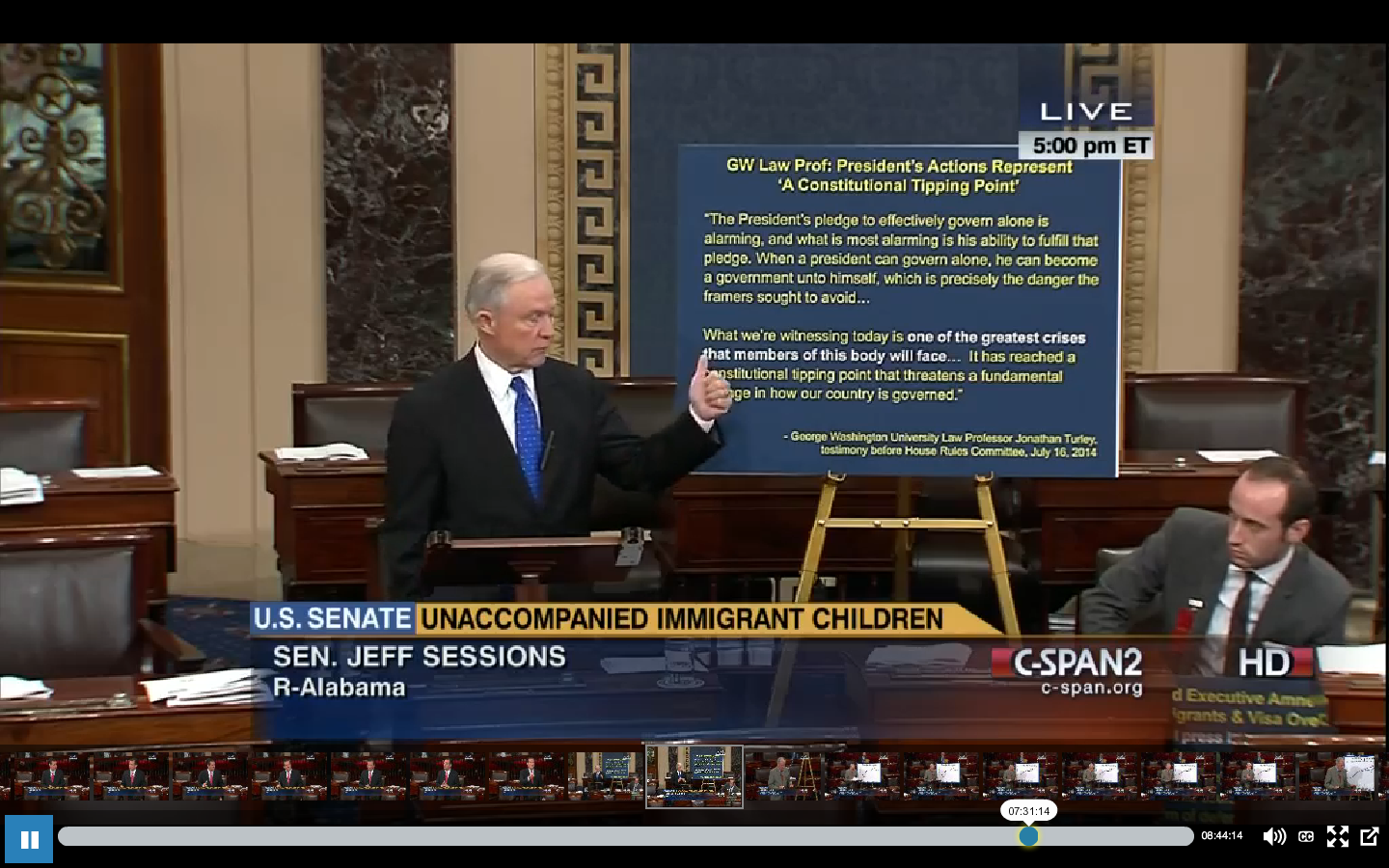
The display used in the Senate debate featured a quote from my recent
testimony before the House Rules Committee on July 16, 2014:
“The President’s pledge to effectively govern alone is
alarming, and what is most alarming is his ability to fulfill that
pledge. When a president can govern alone, he can become a government
unto himself, which is precisely the danger the framers sought to avoid .
. .
What we’re witnessing today is one of the greatest crises that members
of this body will face . . . it has reached a constitutional tipping
point that threatens a fundamental change in how our country is
governed.”
(I am inclined now to give all my future congressional testimony on huge blue boards like this one for emphasis).
I testified (
here and
here and
here) and
wrote a column on President Obama’s increasing circumvention of Congress in negating or suspending U.S. laws. I
ran another column
listing such incidents of executive over-reach. My prior testimony has
discussed unilateral actions in the immigration field that do raise
separation issues.
I have also noted that some of these actions probably do fall within
the strike zone for the president in using executive power. In areas
like environmental law, the president has been given broader authority
under statutes like the Clean Air Act.
The problem is that the
President has not offered details on the new round of unilateral
actions. Some reports indicate that millions might be given new status.
Of course, even concluding that the President can act does not mean
that he should act without congressional action. Major changes in these
areas should not be the result of unilateral action in my view. The
Madisonian system is designed to allow different constituencies to come
to bear in the bicameral system to take factional disputes and convert
them into majoritarian compromises. The result has greater legitimacy
as the result of the legislative product and often constitutes a better
product after being put through the difficult drafting and amendment
process. During times of division, less may get done. Both sides must
either compromise or seek to change the balance of power in the next
election. If the country and Congress is too divided to reach a
compromise, unilateral action will only deepen the questions of
legitimacy and over-reach.
Oooooooh! A swing and a miss on that sports analogy.
We will have to wait to see the specific unilateral actions to judge
their constitutionality. However, for those of us who are uncomfortable
with the rise of the über presidency in the United States, the
suggestion of a president dictating a massive change in the status of
millions of people raises many of these same concerns.
"Comrade Turley, your black mariah is here for you."